7 Things That Happen to Activewear Inside a Suitcase Over a Long Weekend
Quick Answer: Heat, compression, and trapped moisture are the three things a suitcase supplies in abundance, and each one degrades elastane and coatings faster than normal wear does. Roll rather than fold, never pack anything even slightly damp, keep the bag out of hot cars and boots, and unpack within hours of arriving. Most travel damage to activewear is not from the journey - it is from the four hours the bag sat closed in a warm boot afterwards.
You wore them twice over a long weekend. They came home smelling different, sitting differently at the waist, and with a crease across the thigh that has not come out.
Here is exactly what happened in that bag.
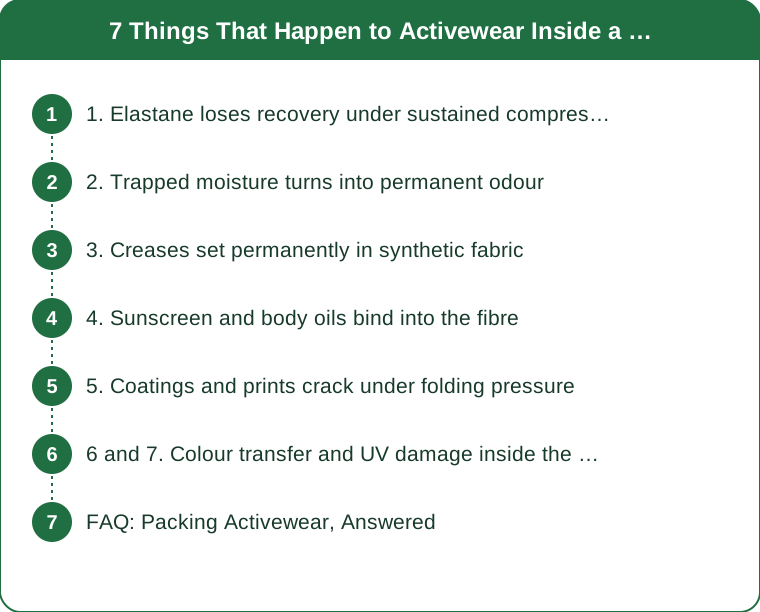
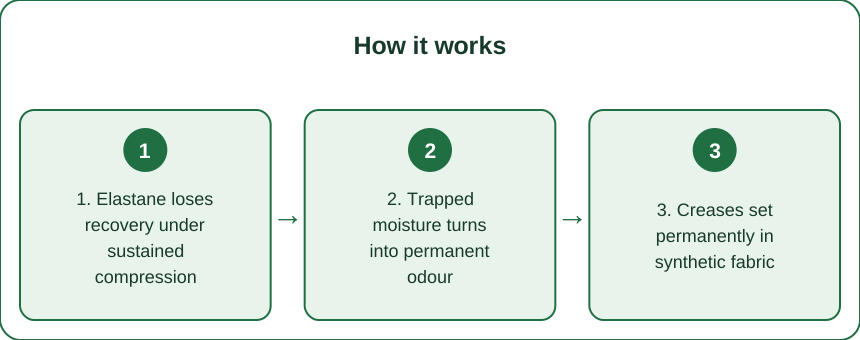
1. Elastane loses recovery under sustained compression
A packed suitcase applies constant pressure for days. Elastane - the fibre that provides stretch and recovery - is designed for repeated stretch-and-return cycles, not for being held compressed at a fixed point for 96 hours.
Heat multiplies the effect substantially. Elastane is heat-sensitive, and a suitcase in a warm car interior can exceed 50C easily on a late-summer afternoon. Compression plus heat is the specific combination that produces permanently slackened waistbands.
The waistband is where it shows first. It is the thickest, most elastane-dense part of the garment and usually the part folded over on itself, so it takes the most concentrated pressure.
What to do: roll rather than fold, pack activewear on top rather than at the bottom, and never leave a packed bag in a car in the sun. Rolling distributes pressure across a curve rather than concentrating it in a crease line.
How to tell it happened: the waistband no longer springs back when stretched and released, or sits lower than it used to after ten minutes of wear.
2. Trapped moisture turns into permanent odour
Slightly damp is enough. Fabric that feels dry to the touch can still hold meaningful moisture, and a sealed bag at 30C is close to ideal conditions for bacterial growth in the fibres.
Synthetic fibres hold odour compounds differently from cotton. Polyester in particular binds the oily compounds that cause smell, which is why a synthetic top that has smelled once tends to smell again even after washing.
Four days is well past the threshold. Odour that develops over a long weekend in a closed bag frequently survives normal washing, at which point you need a dedicated sports detergent or a vinegar soak.
What to do: never pack anything damp, not even slightly. Use a separate breathable bag for worn items rather than a plastic one, and open the suitcase within a couple of hours of getting home.
If it already happened: a 30-minute soak in cool water with a cup of white vinegar before a normal wash lifts a surprising amount. Skip fabric softener entirely, which seals odour compounds in rather than removing them.
3. Creases set permanently in synthetic fabric
Synthetics take a set from heat and pressure. Unlike cotton, which creases and releases, polyester and nylon can hold a fold semi-permanently if they are compressed while warm - which is the definition of a packed bag in summer.
Folded items crease along the fold; rolled items do not. This is the single clearest argument for rolling, and it matters more for technical fabric than for anything else in the bag.
The crease is often visible only when worn. A pale horizontal line across the thigh of dark leggings appears under tension, which is why it is not obvious when you unpack.
What to do: roll, and roll loosely. Tight rolls solve the crease problem while re-creating the compression problem.
To remove a set crease: hang in a steamy bathroom for 20 minutes. Never apply a hot iron directly to technical fabric, which will melt or glaze the surface permanently.
4. Sunscreen and body oils bind into the fibre
Time is the variable that turns a smear into a stain. Sunscreen residue on a worn garment is removable for the first few hours and increasingly difficult after that, particularly in heat.
Avobenzone reacts with minerals to produce orange marks. Four days in a warm bag is more than enough time for this reaction to complete, and the result behaves like a dye rather than a soil.
Body oils do the same thing more slowly. Sebum absorbed into synthetic fibre oxidises over days and produces both discolouration and the base for persistent odour.
What to do: rinse worn items in a sink at the destination, even without detergent. Thirty seconds of cool water removes most of what would otherwise bind over the following days.
On arrival home: pre-treat any visible marks with a drop of dish soap and a soft brush before the first wash. Once heat from a dryer has been applied, the window has closed.
5. Coatings and prints crack under folding pressure
Printed logos and taped seams are the vulnerable points. These are surface applications rather than fibre properties, and folding a print against itself under pressure for days produces micro-cracking.
Heat softens the adhesive first, then pressure deforms it. This is why the damage happens in warm-weather travel and not in a cool overhead locker.
Reflective details are the most fragile of all. Reflective print on running gear degrades quickly under folded compression and does not recover.
What to do: turn printed items inside out, roll them with the print facing outward on the curve, and never place anything heavy on top of a bag containing them.
Once cracked, it does not come back. This is one of the genuinely irreversible categories, which is why prevention is the whole strategy.
6 and 7. Colour transfer and UV damage inside the bag itself
6. Colour transfers between items in a warm bag
Damp plus heat plus contact is how dye migrates. New dark activewear in particular can release dye onto lighter items when the two are pressed together in a warm, humid bag.
Sweat accelerates it. Slightly salty moisture is a more effective transfer medium than plain water, so worn items are considerably more likely to bleed than clean ones.
Light greys and whites are where it shows. The transfer is often uniform enough that it reads as the item having gone dull rather than as an obvious stain.
What to do: separate new dark items from light ones, use a laundry bag for worn kit, and wash new dark activewear once before it travels.
If transfer has happened: wash immediately in cool water with an oxygen-based product. The longer it sits, the more permanent it becomes.
7. UV degradation continues inside a light-coloured bag
This one surprises people. UV exposure degrades elastane and weakens nylon, and a light-coloured suitcase or a bag left in direct sun on a beach or a poolside does transmit meaningful light.
Chlorine and salt make it much worse. Fabric that has been in a pool or the sea and is then packed still wet, in a warm bright bag, is exposed to chlorine, salt, heat, and light simultaneously.
Swimwear-adjacent activewear ages fastest for exactly this reason. It is the category that reliably meets all four conditions in one trip.
What to do: rinse anything that has met chlorine or salt water in fresh water before packing, even briefly, and keep bags out of direct sun.
The honest summary: most of the damage in this list is caused after the journey rather than during it, in the hours when a warm bag sits closed in a hall or a boot. Unpack first, everything else second.
FAQ: Packing Activewear, Answered
Should I roll or fold leggings when packing?
Roll, loosely. Folding concentrates pressure along a crease line, and synthetic fabric can take a permanent set from heat and pressure at that fold. Loose rolling distributes it across a curve.
Why does my activewear smell after a trip even though I washed it?
Synthetic fibres bind the oily compounds that cause odour, and days in a warm sealed bag lets that binding complete. A 30-minute cool soak with white vinegar before washing lifts a lot of it; fabric softener makes it worse.
Does packing actually damage leggings?
Sustained compression plus heat degrades elastane recovery, particularly in the waistband. A bag left in a hot car is the worst case, and it does more damage in an afternoon than weeks of ordinary wear.
How do I get a crease out of technical fabric?
Hang it in a steamy bathroom for about 20 minutes. Never iron technical fabric directly - the heat glazes or melts the surface permanently.
TL;DR:
- Heat, compression, and trapped moisture are what a suitcase supplies, and all three degrade elastane and coatings faster than wearing the garment does.
- Roll loosely rather than folding; folding sets permanent creases in synthetic fabric under heat.
- Never pack anything even slightly damp, and use a breathable bag rather than plastic for worn items.
- Rinse sunscreen, chlorine, and salt off at the destination - the binding happens over days, not hours.
- Turn printed and reflective items inside out; cracked coatings do not recover.
- Keep the bag out of hot cars, and unpack within a couple of hours of arriving. Most travel damage happens after the journey ends.
See It in Motion
Seen here: Super High Waist Embossed Yoga Leggings with Inner Pocket — shop it on bubblelime.com
Keep Reading
This article is for general informational and styling purposes only. Fit, sizing, and product availability may vary.