7 Things That Happen When You Line-Dry Activewear Outside
Quick Answer: Line-drying activewear outside avoids heat damage but introduces UV damage, and for elastane the UV is the bigger threat. Direct summer sun degrades elastane and fades dyes measurably within a few hours of cumulative exposure; it also stiffens fabric, sets residual body oils, and can leave shoulder marks from the hanger. Dry synthetics in the shade or indoors, flat or over a wide bar, and the whole problem disappears.
You stopped tumble-drying your leggings because everyone told you the dryer kills them. Correct. So they go on the line, in the sun, where the air is free and the smell is better.
Then a season later the black pair is a bit gray, the waistband has lost some snap, and there is a hard spot at the shoulder of your favorite top. Sunlight did all of that, and it is worth knowing which parts are avoidable.
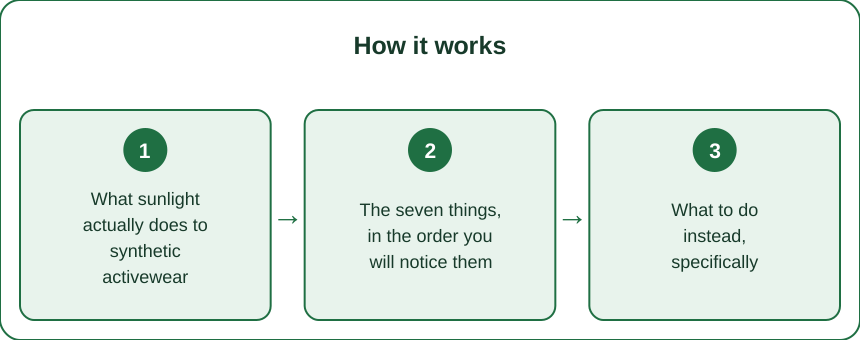
What sunlight actually does to synthetic activewear
The mechanism is photodegradation: ultraviolet radiation carries enough energy to break chemical bonds in the polymer chains that make up the fiber. Broken chains mean shorter chains, and shorter chains mean weaker, stiffer, less elastic fabric.
Not all fibers care equally. Polyester is comparatively UV-stable and takes a long time to show damage. Nylon is more vulnerable and yellows with prolonged exposure. Elastane — spandex, Lycra — is the most vulnerable of the three by a wide margin, and it is the one component whose failure you actually notice, because it is what makes the garment hold its shape.
The uncomfortable arithmetic: a legging is typically twelve to twenty-five per cent elastane, and that minority component determines the useful life of the garment. Damage the elastane and the polyester around it is still perfectly intact in a garment that no longer fits.
Below, the seven things that actually happen, in the order they show up.
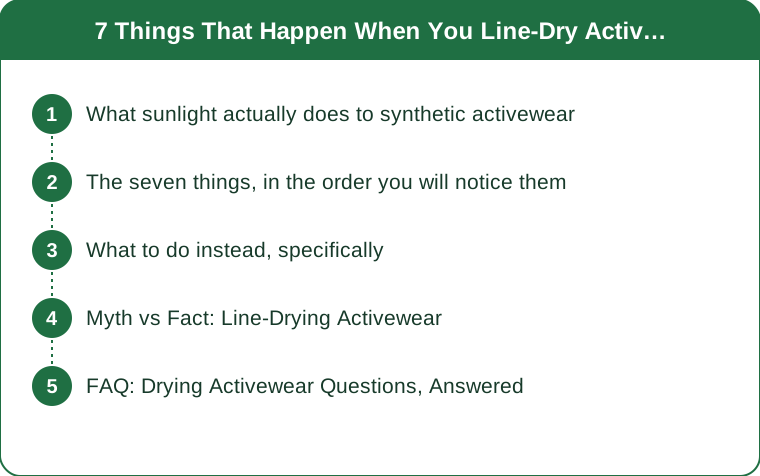
The seven things, in the order you will notice them
1. The color goes first, and unevenly
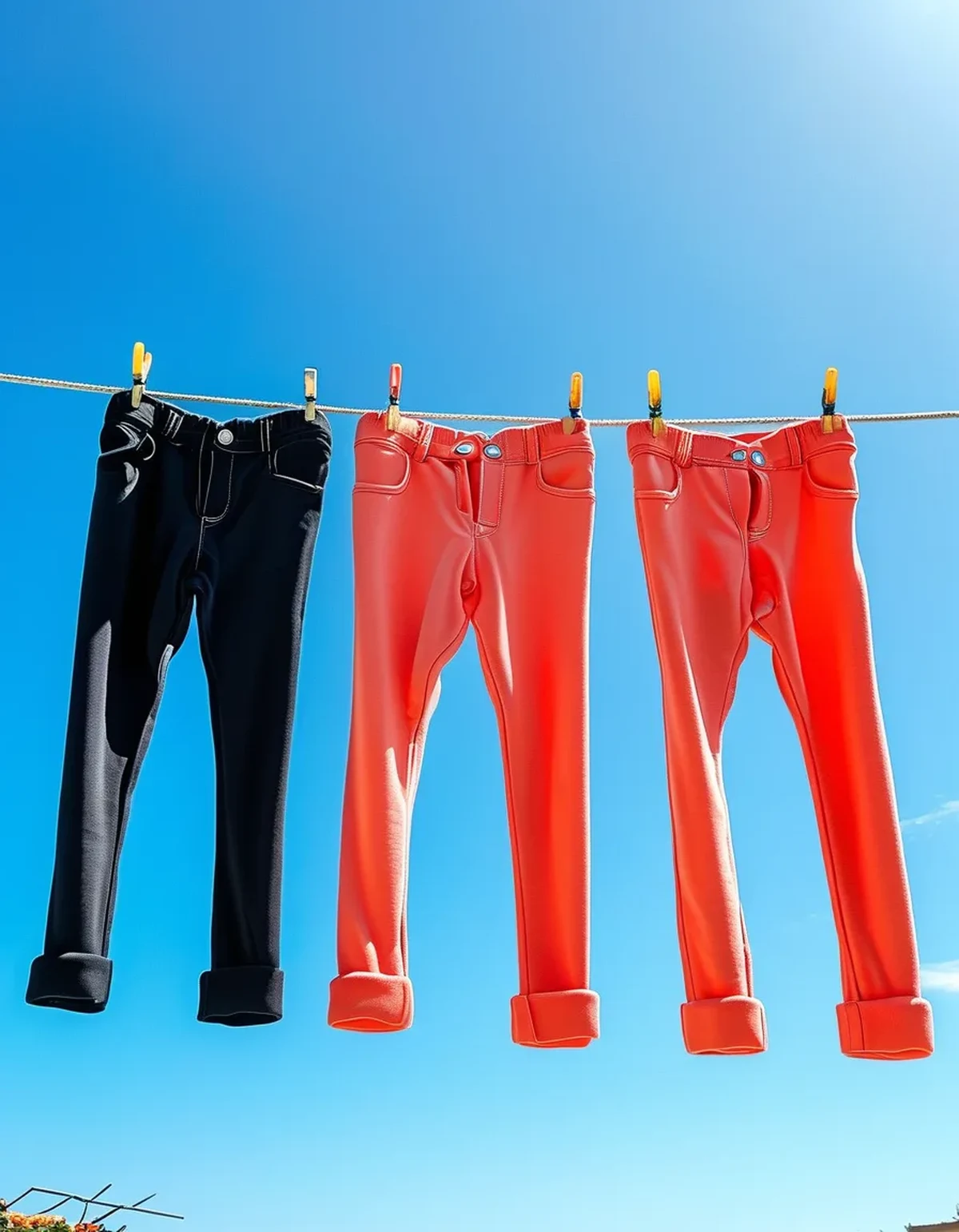
Dye fading is the earliest visible effect and it is not uniform. The side facing the sun fades and the side facing away does not, which on a garment hanging still for hours produces a genuinely two-tone result. Deep blacks shift toward gray-brown, and bright synthetics — coral, fuchsia, turquoise — fade fastest because the dye classes used for those shades are the least lightfast. If you have ever pulled a top off the line and thought it looked dusty, that was fading, not dirt.
2. Elastane loses recovery
The functional one. Degraded elastane does not snap back the way it did, so waistbands loosen, cuffs stop gripping, and leggings start needing a hitch mid-session. This happens well before anything looks worn. The tell is that the garment feels fine when you put it on and has migrated within twenty minutes — that is recovery loss, not sizing.
3. The fabric stiffens and feels papery
Shortened polymer chains produce a hand that people describe as crisp, papery or plasticky. It is most obvious in a fabric that used to be described as buttery. Once it is there it does not come back.
4. Body oil and sunscreen residue bakes in
Anything the wash did not fully remove gets set by heat and UV. This is why line-dried gym clothes sometimes develop a smell that survives washing — the residue has been cooked into the fiber rather than rinsed out. Sunscreen residue is the worst offender, and it also causes the yellow-orange staining on light fabrics that people mistake for sweat.
5. Shoulder marks and hanger dents
Wet activewear is heavy and stretchy. Hanging it from a narrow line or a thin hanger concentrates that weight on a small area of already-stretched fabric, and it sets that way as it dries. The result is a permanent bump at the shoulder or a stretched band along a waistline.
6. Elastic in the band goes before the fabric does
The internal elastic in a waistband is often a different, less protected material than the outer fabric, and it sits directly at the top of the garment where sun exposure is highest on a line. Waistband failure while the leg fabric is still perfect is the classic line-drying signature.
7. The good one: no heat damage, and better smell
To be fair to the line, everything above should be weighed against what the tumble dryer does — direct heat, mechanical abrasion, and lint. Air-drying genuinely avoids all of that, and the airing genuinely helps with odor. The problem is not the drying. It is the direct sun.
What to do instead, specifically
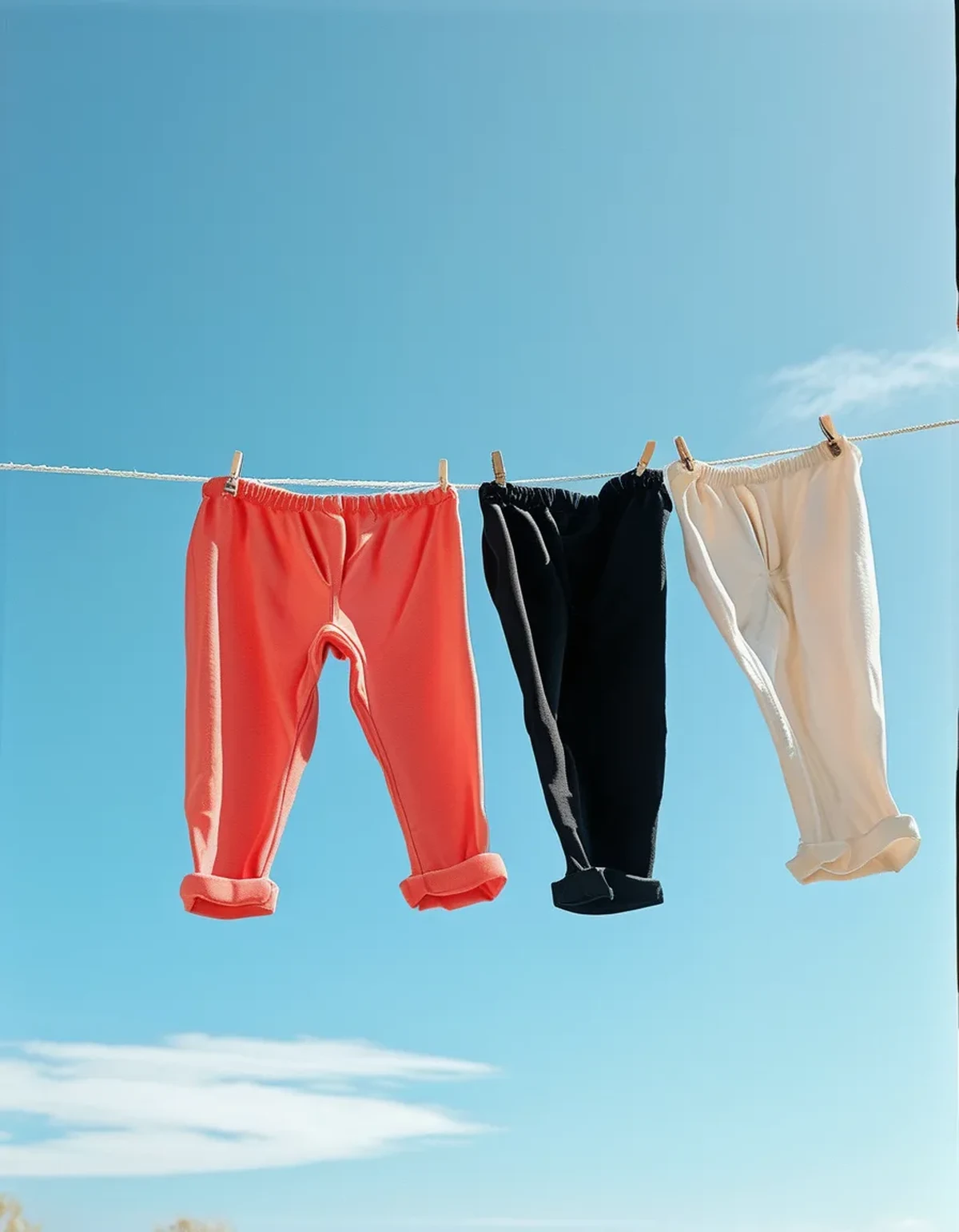
Dry in the shade. This single change removes items one through four and most of six. A shaded line, a covered balcony, a north-facing window, or indoors on an airer. You keep every benefit of air-drying and lose the UV.
Dry inside out. The face of the fabric — the part that shows and the part with the dye — spends the drying time on the inside. This is the free version of the fix for anyone who has nowhere shaded.
Dry flat, or over a wide bar. Fixes item five. A drying rack, a towel on a flat surface, or a bar at least an inch wide distributes the wet weight instead of concentrating it. Never hang wet leggings by the waistband on a thin line.
Dry in the morning or late afternoon. UV intensity peaks in the middle of the day. Two hours at nine in the morning does considerably less damage than two hours at one in the afternoon.
Take them in as soon as they are dry. Almost all of the cumulative UV damage on line-dried clothing is acquired in the hours after it was already dry. This is the single easiest change on this list and the one most people never make.
And fix the wash, so the residue is not there to bake in. Cold water, a detergent without added softener, a half cup of white vinegar in the rinse periodically, and never fabric softener. Sunscreen residue specifically needs a proper wash to come out — if you have been swimming or applied sunscreen, do not let those items sit in a bag before washing.
Myth vs Fact: Line-Drying Activewear
Myth: Sun kills the smell. Fact: Sunlight does have a modest antibacterial effect on the surface, which is why line-dried laundry often smells fresh. But the odor problem in activewear is bacteria and residue living inside the fiber structure, and UV does not penetrate to reach them. What actually removes it is the wash, and what makes it permanent is heat setting the residue in — which the sun does very effectively.
Myth: Air-drying is always gentler than the dryer. Fact: For cotton, yes, almost always. For an elastane-rich synthetic in direct summer sun, an hour on a low-heat dryer cycle may do less measurable harm than four hours in the sun. Shade-drying beats both by a distance.
Myth: Dark colors are more resistant because they are already dark. Fact: Dark colors absorb more energy and get hotter, and black synthetics on a line in summer can reach temperatures well above ambient. They fade differently rather than less, and the fabric underneath takes more thermal load.
Myth: One sunny afternoon does not matter. Fact: One does not. The damage is cumulative and it is calculated across a season. Twice a week for a summer is roughly thirty exposures, which is entirely enough to explain a waistband that has gone slack a year sooner than it should have.
FAQ: Drying Activewear Questions, Answered
How long is too long in direct sun?
There is no clean threshold, but a useful rule: if it is dry, it is done. The damage is roughly a function of total UV dose, so anything after dryness is pure cost with no benefit. Under strong midsummer sun, meaningful dye fading on vulnerable colors starts within a couple of hours.
Does UV-protective activewear resist this better?
Somewhat. UPF-rated fabrics are usually tightly woven or treated to block UV transmission, which does mean less radiation reaching the interior of the fabric. It does not protect the outward-facing surface or the elastane in it, and treatments wash out over time. Do not treat a UPF rating as permission to line-dry in full sun.
What about drying on a radiator or heated airer in winter?
Better than sun for UV and worse for heat. Direct contact with a hot radiator is genuinely damaging to elastane — the same mechanism as the tumble dryer, concentrated. An airer near a radiator rather than on it is fine.
Is there any activewear I can safely sun-dry?
Cotton-heavy items and anything with no elastane at all — a cotton tee, a rope-strap bag, a towel. As soon as there is stretch in the garment, shade is the better call.
TL;DR:
- Sun does three kinds of damage to activewear: it fades dye unevenly, degrades elastane so recovery goes, and stiffens the fabric permanently.
- Elastane is the vulnerable component and the one that determines whether the garment still fits.
- Direct sun also bakes in sunscreen and body-oil residue, which is the smell that survives washing.
- Hang flat or over a wide bar — thin lines and hangers set permanent shoulder and waistband marks.
- Shade-dry, inside out, and bring things in the moment they are dry. That is the whole fix.
Air-drying is still the right call. It is the sunlight that is expensive, and moving the line six feet into the shade costs nothing and buys you a season.
See It in Motion
Seen here: Super High Waist Embossed Yoga Leggings with Inner Pocket — shop it on bubblelime.com
Keep Reading
This article is for general informational and styling purposes only. Fit, sizing, and product availability may vary.