7 Things Hard Water Does to Your Activewear That Detergent Cannot Fix
Quick Answer: Hard water contains dissolved calcium and magnesium that react with detergent to form an insoluble residue - the same substance that leaves limescale in a kettle. On activewear it deposits inside the knit rather than on the surface, which produces stiffness, trapped odour, reduced wicking, faded colour, and detergent that stops working properly. The seven effects below are all caused by the same mechanism, and the fixes are the same three things: less detergent, a water softening additive, and periodic acid rinses.
Your leggings have gone stiff. The smell comes back within an hour of putting them on, no matter how well you washed them. The colour looks tired at six months when the last pair lasted two years.
You have changed detergent twice. It did not help.
If you live in a hard water area - and most of the population does - the variable you have not changed is the water itself, and it is doing seven specific things to synthetic fabric.

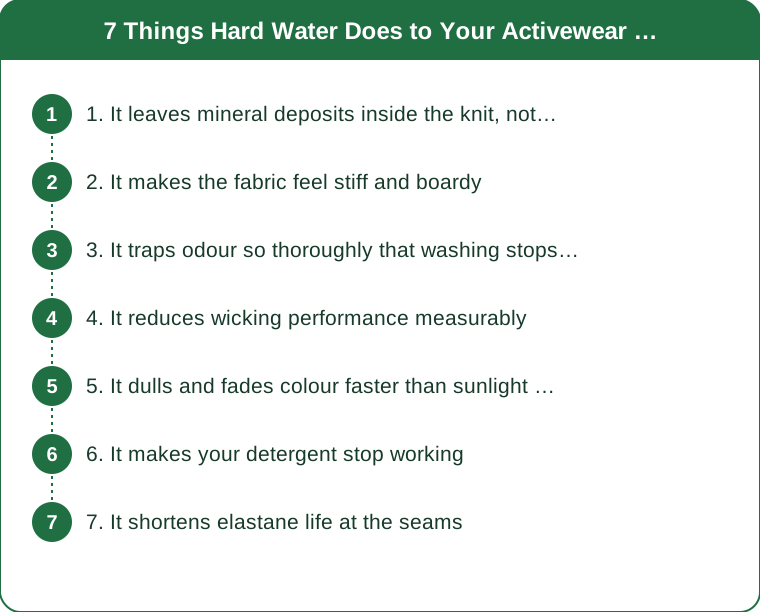
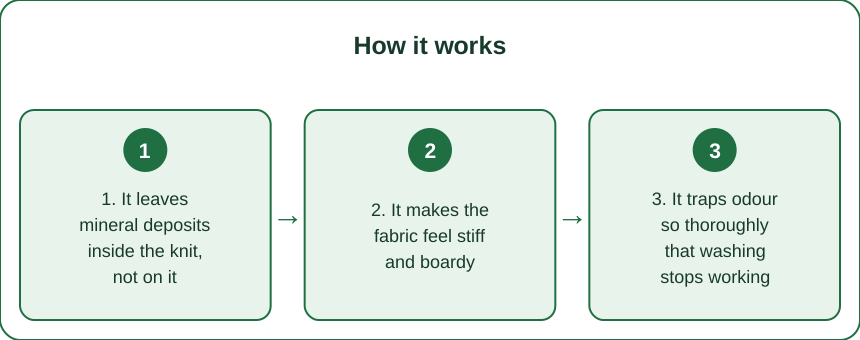
1. It leaves mineral deposits inside the knit, not on it
This is the root cause of almost everything else on this list.
Hard water contains dissolved calcium and magnesium. When those minerals meet the surfactants in detergent, they react and form an insoluble compound - historically called soap scum, chemically a metal salt. It does not dissolve and it does not rinse away cleanly.
On a plate it sits on the surface and you can see it. On a knitted synthetic fabric, it settles between and around the individual fibres, deep in the structure of the knit.
This matters because activewear knits are built with enormous internal surface area - that is what makes them wick. Every one of those fibre surfaces is a place for residue to accumulate. A cotton towel has a fraction of the internal surface area of a technical legging, which is one reason activewear shows hard water damage far sooner than the rest of your laundry does.
The deposits build slowly and invisibly. There is no point at which you see them appear - the fabric just gradually stops behaving the way it used to, over months, which is exactly the profile that gets blamed on quality.
2. It makes the fabric feel stiff and boardy
The stiffness is mechanical, and you can feel exactly what is happening.
A knit is soft because the individual fibres can move independently against each other. Mineral deposits bridge the gaps between fibres, effectively cementing them into position. The fabric loses its ability to drape and starts to feel like it has been starched.
The usual description is that the leggings feel like they have got tougher, or that the fabric has gone cheap. Neither is happening - the fibres are unchanged, they are just no longer free to move.
The diagnostic test: if a garment feels stiff dry, gets softer while wet, and returns to stiff when dry, that is mineral deposit rather than fibre damage. Actual fibre degradation does not reverse when wet.
This is also why fabric softener makes it worse rather than better. Softener coats fibres to make them slide past each other, which does mask the stiffness briefly - but softener is itself a deposit, it clogs the wicking structure, and in hard water it reacts with the minerals to leave more residue. Fabric softener should not go anywhere near technical activewear regardless of the water, and in hard water it is actively compounding the problem.
3. It traps odour so thoroughly that washing stops working
Mineral deposits create a physical scaffold that holds body oils and bacteria out of reach of the detergent.
Activewear smell comes from bacteria metabolising the oils and sweat residues held in the fabric. The reason synthetics smell worse than cotton is that oil binds readily to polyester and nylon.
Add mineral deposit and two things happen. The deposits give the oils more surface to bind to, and they physically shield the interior of the knit from water flow, so the detergent never reaches what it needs to remove.
The result is the specific and maddening pattern people describe: the garment smells clean out of the wash and smells strongly within ten minutes of being worn. Body heat and moisture reactivate what was never actually removed.
Adding more detergent makes this worse, not better. In hard water, the extra detergent is consumed reacting with the minerals before it can clean anything, which produces more residue and no additional cleaning. This is the single most common mistake in hard water areas.
What works instead: a white vinegar rinse (half a cup in the rinse cycle) dissolves mineral deposits and, for stubborn cases, a soak in a solution of vinegar and water for an hour before washing. Do not combine vinegar and detergent in the same cycle - use it in the rinse.

4. It reduces wicking performance measurably
Wicking is a capillary effect, and capillaries are exactly what mineral deposits block.
Moisture-wicking works because the fine spaces between and within fibres pull water along by capillary action, spreading it across a wide surface to evaporate. The whole mechanism depends on those channels being open and on the fibre surfaces having the right treatment.
Mineral deposits do both kinds of damage - they physically narrow the channels and they cover the treated surfaces.
The practical experience: sweat stops spreading and starts pooling. A top that used to feel damp-but-functional now feels wet in patches. The garment takes noticeably longer to dry on the line, which is often the first thing people notice.
The drying-time test is a genuinely useful diagnostic. If a technical garment now takes significantly longer to dry than it did when it was new, and it has not been through anything that would damage the fibre, mineral loading is the most likely explanation. It is easy to check because most people have a rough sense of how long a favourite garment takes.
The encouraging part is that this one is largely reversible. Removing the deposits restores most of the wicking function, because the fibre itself has not been altered.
5. It dulls and fades colour faster than sunlight does
A layer of white mineral residue sits over the dyed fibre and scatters light.
The colour has not necessarily gone anywhere. The fabric is covered by a translucent whitish film that scatters incoming light before it reaches the dye and again on the way back out. The effect is a chalky, washed-out appearance, most visible on dark and saturated colours.
Black is where it shows first, which is unfortunate given how much activewear is black. The characteristic look is black that has become a flat charcoal with a slightly dusty cast.
How to tell mineral haze from genuine fading: wet a small area. If the colour comes back strongly when wet and dulls again when dry, it is surface residue. True dye loss looks the same wet and dry.
Iron in the water is a separate and nastier problem. Some hard water carries dissolved iron, which oxidises and deposits as rust - this produces yellowing or orange-brown discolouration on whites and light colours, and unlike calcium residue it can permanently stain. If your whites are going yellow rather than grey, iron rather than hardness is the likely culprit and it needs a rust-specific treatment rather than a water softener.
6. It makes your detergent stop working
A meaningful fraction of every dose is consumed by the water before it reaches your clothes.
Surfactants work by having one end that binds oil and one that binds water. Calcium and magnesium ions bind to the water-loving end and take that molecule out of service. In genuinely hard water, a substantial portion of a normal detergent dose is neutralised this way before any cleaning happens.
This produces a self-reinforcing loop that is worth naming clearly:
- Clothes are not getting clean
- You add more detergent
- More detergent reacts with more minerals
- More residue is deposited in the fabric
- The fabric holds more oil and smells worse
- Return to step 1
Breaking the loop means using less detergent, not more - which is completely counterintuitive and is the reason this problem persists in so many households.
The actual solution is a water softening additive - washing soda, or a commercial laundry softening product. These bind the calcium and magnesium before they can react with the detergent, which means your normal dose does its normal job. This is much more effective than switching detergent brands, because every detergent has the same vulnerability.
And use the right amount for the load. Activewear loads should be small and detergent doses should be modest - most people use two to three times what is needed, which in hard water is the worst possible error.
7. It shortens elastane life at the seams
This is the one that actually damages the garment rather than coating it.
Elastane - the stretch fibre in almost all activewear - is the most vulnerable component in the blend. It degrades with heat, chlorine, oils, and mechanical stress, and it is present in small percentages doing a large amount of work.
Mineral deposits contribute in two ways. Stiffened fabric distributes stress unevenly, so the strain concentrates at seams and high-stretch areas instead of spreading across the whole garment. And deposits act as tiny abrasive particles within the knit, mechanically wearing the fibre with every stretch cycle.
The result shows up as waistbands losing recovery early, seams going wavy, and the knee area bagging sooner than it should - which people reasonably interpret as the garment simply wearing out.
Unlike everything else on this list, this part is not reversible. Once elastane has degraded, no rinse restores it. Which is the argument for addressing hard water early rather than after the garment already feels wrong.
The three-part protocol, for any hard water area:
- Use less detergent than the box says, and add washing soda or a softening product to the wash
- White vinegar in the rinse, roughly half a cup, every third or fourth wash
- Wash cool and skip fabric softener entirely - heat accelerates both deposit formation and elastane degradation
And if you want to know whether this applies to you: water hardness is published by every water supplier, usually by postcode, and takes about a minute to check. Limescale in the kettle is a reliable informal indicator - if the kettle furs up, your leggings are getting the same treatment.
TL;DR:
- Hard water minerals react with detergent to form residue that settles inside the knit, where activewear’s huge internal surface area collects it fast.
- The seven effects - stiffness, trapped odour, reduced wicking, dull colour, dead detergent, slow drying, early elastane failure - all come from that one mechanism.
- Adding more detergent makes it worse. More detergent means more reaction and more residue.
- Fix it with three things: a softening additive, less detergent, and a white vinegar rinse every few washes.
- Six of the seven are reversible. Elastane degradation is not - which is the reason to act before the garment already feels wrong.
Check your water hardness by postcode, and look at your kettle. If it furs up, that is what is happening inside your leggings.
See It in Motion
Seen here: High Waist Embossed Yoga Leggings with Side Pockets — shop it on bubblelime.com
Keep Reading
This article is for general informational and styling purposes only. Fit, sizing, and product availability may vary.