7 Fabric Differences Between Two Leggings That Look Completely Identical
Quick Answer: Two leggings can share the same fibre content, the same colour and the same price and behave completely differently, because the label describes the ingredients and not the construction. The seven variables that actually predict performance are knit density, elastane type and placement, yarn quality, finish, gauge consistency, recovery rate and dye method — and five of the seven can be checked by hand in under a minute.
You own two pairs of black leggings. Same fibre content on the tag, similar price, bought within a few months of each other. One still looks new and one went transparent and baggy by spring.
The difference was visible on the rail. You just did not know what to look at.
1 and 2: Knit density and gauge consistency
1. Knit density — the single biggest predictor
Density is how tightly the yarns are packed, usually expressed as grams per square metre (GSM). Two fabrics with identical fibre content at 190 GSM and 250 GSM are effectively different products. The denser one is more opaque, more durable, more compressive and warmer; the lighter one is cooler and cheaper to make.
Most quality complaints about leggings — transparency in a squat, quick thinning at the seat, loss of shape — trace back to density rather than fibre. The useful range for opaque, durable leggings is roughly 250 to 320 GSM. Below 220 you are in summer-weight territory and should expect some sheerness.
The in-shop test: hold the fabric up to a light and stretch it 20 percent in both directions. If the light comes through noticeably under mild stretch, it will be sheer on your body under real stretch.
2. Gauge consistency
Gauge is the fineness of the knit, and consistency across the garment is a quality marker that nothing on the label reveals. Cheap production runs faster, and faster knitting produces small variations in loop size. Those variations become visible as faint horizontal banding after a few washes, and they become weak points that thin first.
The test: stretch a section flat against a window or a lamp and look for uneven light transmission across the surface. A good fabric transmits evenly. A poor one shows a subtle stripe pattern that is invisible unlit.
3 and 4: Elastane type, percentage and placement
3. Elastane percentage is less informative than everyone thinks
A tag saying 20 percent elastane tells you the proportion by weight, not the quality of the elastane or how it is incorporated. Two leggings at the same percentage can have entirely different recovery.
What matters more is whether the elastane is bare or covered. Bare elastane is knitted in directly and is cheaper. Covered elastane — wrapped in nylon or polyester before knitting — is protected from abrasion, chlorine, sweat and heat, and lasts considerably longer. Brands using covered yarns often say so; brands that do not, do not.
Useful ranges: 12 to 20 percent for general training, 20 to 28 percent for compression. Below 8 percent, recovery is usually poor regardless of everything else.
4. Where the stretch actually is
A fabric can be two-way (stretching mainly in one direction) or four-way (stretching and recovering in both). Four-way is standard in good activewear and noticeably absent in cheaper pieces, where you will find plenty of horizontal stretch and very little vertical.
The test that takes five seconds: pull the fabric horizontally, then vertically. If one direction gives dramatically more than the other, it is two-way, and it will bag at the knee, because the knee needs vertical stretch and vertical recovery specifically.

5 and 6: Yarn quality and recovery rate
5. Yarn quality — the invisible one
Nylon and polyester both come in wide quality ranges. Higher-grade yarns are finer, more uniform, and produce fabric that resists pilling and holds colour. Lower-grade yarns have more variation along their length, which creates weak points and a duller surface.
The practical proxy is surface feel under friction, not under a stroke. Rub the fabric against itself briskly for ten seconds. A good yarn stays smooth. A poor one develops a faint fuzz almost immediately — that is the beginning of pilling, and you have just watched three months of wear happen in ten seconds.
Nylon-based fabrics generally feel smoother and more durable than polyester at the same price, and cost more. Polyester dries faster and holds printed colour better. Neither is universally better, but a very cheap nylon is usually worse than a decent polyester.
6. Recovery rate — the one that predicts bagging
Recovery is how fast and how completely the fabric returns after stretch, and it is the property that determines whether you get knee bagging by week six.
The test: stretch a section as far as it comfortably goes, hold for ten full seconds, and release. Watch it. Good fabric snaps back essentially instantly and shows no distortion. Mediocre fabric returns over two or three seconds. Poor fabric shows a visibly looser area that is still there after five seconds.
This single test is the most predictive thing you can do in a shop, and almost nobody does it because it requires holding the stretch long enough to matter. Two seconds tells you nothing; ten seconds separates them clearly.
7 plus the finish: dye method and surface treatment
7. Dye method
How colour got into the fabric determines how long it stays. Solution-dyed fibres have pigment added before the fibre is extruded, so the colour goes all the way through and is highly resistant to fading, chlorine and washing. Piece-dyed fabric is coloured after knitting, which is cheaper and fades from the surface inward.
You can often tell by stretching a coloured fabric hard and looking at the stretched area. If it goes noticeably paler under stretch, the colour is sitting on the surface and the yarn core is lighter — that pair will fade unevenly, especially at the seat and knee where stretch is greatest.
Black is the hardest colour to keep, and the most common. A black legging that turns slightly grey-brown after a season was piece-dyed with a cheap process.
The finish layer
Separately from the fabric itself, most activewear carries a chemical finish — moisture-wicking treatment, antimicrobial, softener, or a brushed handle. Finishes wash out. A fabric that feels remarkably soft in the shop and ordinary after five washes was carrying a softener, and what you are feeling now is the actual fabric.
This is worth knowing because hand-feel in a shop is the least reliable signal available and the one everybody uses. A slightly less soft fabric with better density and recovery will outperform a buttery one every time.
Seasonally: as leggings move under longer layers and into more sitting-heavy days this autumn, density and recovery matter more than breathability, which reverses the summer priority.
FAQ: Fabric Comparison Questions, Answered
What is the fastest single check if I only do one?
The ten-second recovery test. Stretch, hold ten seconds, release, and watch how it returns. It predicts bagging, shape loss and general longevity better than any other quick check.
Does GSM appear on labels?
Rarely on consumer tags, sometimes in online product descriptions from brands that are proud of it. Its absence is mildly informative — brands using dense fabric tend to mention it.
Is recycled polyester worse?
Not inherently. Modern recycled polyester performs comparably to virgin for most properties. Quality varies more between suppliers than between recycled and virgin, so the material is not the useful signal here.
Why do two pairs from the same brand differ?
Because brands run multiple fabric platforms across price tiers and refresh them seasonally. The same product name can use a different mill from one year to the next. This is a real and common source of the they changed it experience.
Can I test any of this on leggings I already own?
Yes, and it is worth doing on a pair that disappointed you. Run the recovery test and the light test on an old pair and a pair that lasted. The difference is usually obvious, and it recalibrates what you look for next time.
Does price reliably predict any of this?
Weakly. Price correlates with density and elastane quality up to a mid-range point and then mostly buys branding, fit refinement and finishing. The tests above outperform the price tag.
TL;DR:
- The label lists ingredients; construction decides performance, and construction is not on the label.
- The seven variables: density, gauge consistency, elastane type, stretch direction, yarn quality, recovery rate, dye method.
- The ten-second recovery test is the highest-value check — stretch, hold ten seconds, release, watch.
- Hold to light under 20 percent stretch for sheerness, and rub the fabric against itself for pilling potential.
- Shop softness is mostly a washable finish. Ignore it.
Two minutes of testing in a shop is worth more than an hour of reading reviews, because the pair in your hand is the pair you are buying.
See It in Motion
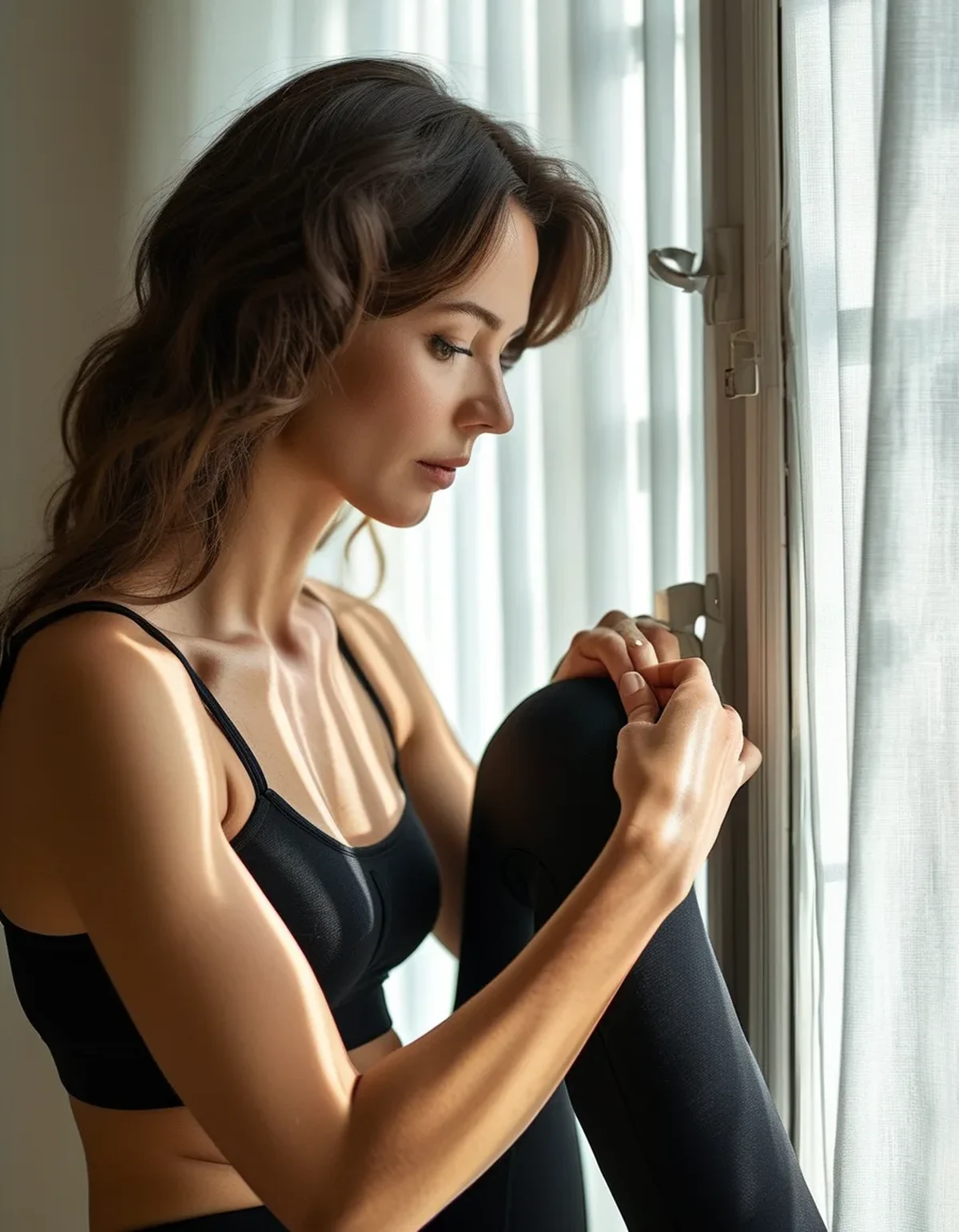
Seen here: High Waist Yoga Leggings with Inner Pocket — shop it on bubblelime.com
Keep Reading
This article is for general informational and styling purposes only. Fit, sizing, and product availability may vary.