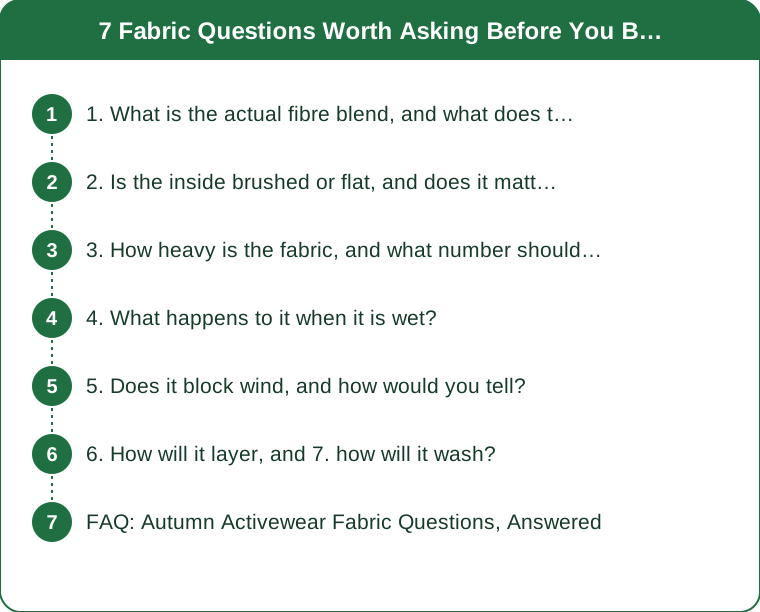
7 Fabric Questions Worth Asking Before You Buy Fall Activewear
Quick Answer: Autumn activewear fails for different reasons than summer activewear. The failure mode is not overheating - it is being cold and damp after you stop. Seven questions sort the pieces that handle that from the ones that do not: what is the fibre blend, is it brushed or flat, how heavy is the fabric, what happens when it is wet, does it block wind, how does it layer, and how will it wash. None of them need special equipment to answer.
The piece that felt perfect in the shop is often the one that leaves you shivering at the car.
Autumn is where fabric choices stop being cosmetic.
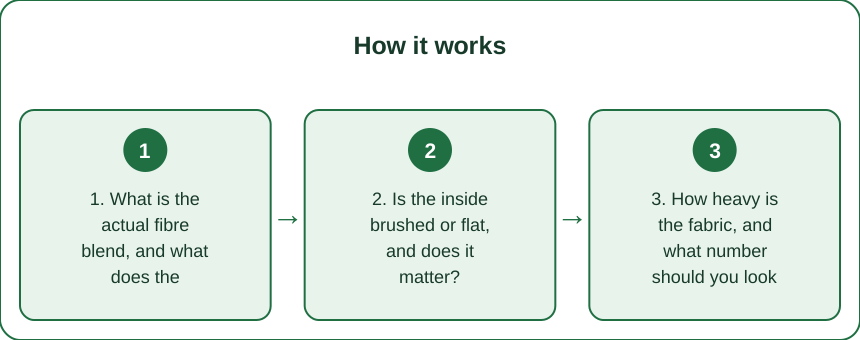
Seven questions, in the order worth asking them.
1. What is the actual fibre blend, and what does the percentage mean?
The number tells you the behaviour, and most people read it as a quality score instead.
Polyester dominant means fast drying, good abrasion resistance, and a tendency to hold odour. It is the workhorse for autumn because drying speed is what keeps you warm after you stop.
Nylon dominant means softer hand, better stretch recovery, and slower drying than polyester. Excellent for tights and less ideal for a top you will sweat into on a cold morning.
Merino in the blend changes the equation. Wool retains a useful amount of insulation when damp and resists odour naturally, which is why it appears in cold-weather base layers. A blend of merino with a synthetic gets most of the benefit with better durability than pure wool.
Elastane percentage is about fit, not warmth. Around 8-15% gives a compressive, shaped fit; under about 5% gives a relaxed one. Higher elastane also means more heat sensitivity in the wash.
Cotton in an autumn training piece is a warning sign. Cotton absorbs moisture and holds it against the skin, which is exactly the failure mode you are trying to avoid. Fine for a post-session layer, wrong for anything you sweat in.
2. Is the inside brushed or flat, and does it matter?
It matters more than almost anything else for the same fabric weight.
A brushed or fleece-backed interior traps a layer of still air against the skin, and still air is what insulation actually is. The same weight of fabric brushed on the inside is noticeably warmer than the same fabric flat.
The trade-off is drying speed and bulk. Brushed interiors hold more moisture and take longer to dry, which matters if you sweat heavily. They also compress less well for packing.
How to check without a label: turn it inside out and run a hand across. A soft, slightly fuzzy surface is brushed; a smooth cool surface is flat.
Where each belongs:
- Brushed: outer tights, mid layers, anything worn in genuinely cold conditions or for low-sweat activity
- Flat: base layers under other things, high-output sessions, anything you need to dry quickly
The common autumn mistake is a brushed base layer under a brushed mid layer. Two moisture-holding surfaces against each other traps sweat in the system, and you end up damp and cold despite being well-dressed.
3. How heavy is the fabric, and what number should you look for?
GSM is the number, and it is the most useful spec on the tag when it is given.
GSM means grams per square metre - the fabric weight. It predicts warmth, opacity and durability better than any marketing description.
Rough ranges for autumn:
- Under 180 gsm: summer weight. Fine as a base layer, too light on its own once mornings are cold
- 200-260 gsm: the autumn sweet spot for tights and mid layers. Warm enough to start cold, breathable enough not to overheat
- 280 gsm and up: winter weight. Warm, opaque, and often too much for autumn until it is genuinely cold
Not every brand lists GSM, and where they do not, weight in the hand is a reasonable proxy. Compare against a piece you already own and know the behaviour of - it is more informative than any adjective on the swing tag.
One thing GSM does not tell you: whether the weight comes from thickness or density. A dense thin fabric and a lofty thick one can weigh the same and behave differently - dense wears better, lofty insulates better.
And on opacity: squat test in the changing room regardless of GSM. Weight correlates with opacity and does not guarantee it, particularly in lighter colours.
4. What happens to it when it is wet?
The autumn question, and the one nobody asks in a dry shop.
Wet fabric conducts heat away from the body far faster than dry fabric. This is why an autumn session that ends damp is so much colder than the temperature suggests, and it is the mechanism behind almost every bad autumn training experience.
Three things determine how a piece handles this:
- Drying rate. Polyester dries fastest, then nylon, then wool, then cotton by a wide margin
- Whether it insulates when damp. Wool is the standout here - it retains meaningful warmth wet, where synthetics lose most of theirs
- How much water it absorbs in the first place. Brushed and heavier fabrics hold more
A test you can do in the shop: put a drop of water on the fabric. Fast spreading and absorption means it will wick and dry; beading and sitting on the surface means either a water-repellent finish or a fabric that will not move sweat. Both exist and you want to know which you are buying.
For rain specifically, check whether the finish is durable water repellent or actual waterproofing. DWR sheds light rain and wets out in sustained rain, and it wears off with washing. It is a useful feature and not a rain jacket.
5. Does it block wind, and how would you tell?
Wind is the largest single variable in how cold an autumn session feels, and most knits do nothing about it.
Wind strips the warm air layer that your clothing has trapped, which is why a still 10 degrees and a windy 10 degrees are completely different experiences.
The shop test: hold the fabric up to your mouth and blow through it. If air passes easily, it will not block wind. If it resists noticeably, there is either a dense weave or a membrane.
Most knit activewear fails this test, which is fine - it is not what knits are for. The answer is usually a wind-resistant outer layer rather than a wind-resistant base.
What to look for in the outer piece:
- A dense woven face rather than a knit
- Wind-blocking panels on the front only, which is a genuinely good design - wind hits the front, and the back stays breathable
- A hem and cuffs that seal, since wind entering at the waist defeats the rest of it
The trade-off is always breathability. Fully windproof means less vapour escapes, which is fine for low-output activity and problematic for hard efforts. Front panels are the common compromise for a reason.
6. How will it layer, and 7. how will it wash?
The two questions that decide whether you actually use the piece.
### 6. Layering compatibility
Autumn is a layering season, so the piece has to work as part of a system rather than alone.
Check the surface friction. A grippy or brushed outer surface fights with anything worn over it, which is why some mid layers are miserable to put a jacket over. Run the piece against another garment and see whether it slides.
Check the cut in the shoulders and arms. A base layer with a bulky shoulder seam creates a pressure point under a pack or jacket. Flat or bonded seams matter more in layered systems than in single pieces.
Check the length. A base layer that rides up under a mid layer exposes your lower back on every reach, which is a very common autumn complaint with an easy fix at purchase.
### 7. Wash behaviour
Read the care label before buying, not after. Anything requiring hand washing will get worn less - that is simply true, and it is worth knowing before you spend.
Three things to check:
- Whether it can be machine washed cold on a normal cycle
- Whether it has a DWR finish, which needs occasional reactivation and degrades with fabric softener
- Whether it has bonded or taped seams, which are heat-sensitive and rule out tumble drying entirely
High elastane content plus frequent washing is the most common cause of a piece losing shape within a season, and cold washing plus hang drying is the whole solution.
FAQ: Autumn Activewear Fabric Questions, Answered
Is merino worth the extra cost for autumn?
For base layers in genuinely cold or variable conditions, often yes - it insulates when damp and resists odour, both of which matter on autumn mornings. For high-sweat sessions or anything abrasion-heavy, a synthetic or a blend usually makes more sense.
What GSM should autumn tights be?
Roughly 200-260 gsm covers most autumn conditions - warm enough for a cold start, breathable enough not to overheat once moving. Below 180 is summer weight and above 280 is generally winter.
Why am I cold after training even in warm clothes?
Almost always damp fabric. Wet fabric conducts heat away far faster than dry fabric, so a heavy piece that holds moisture can leave you colder than a lighter one that dries. Change the top layer as soon as you stop.
Do I need windproof clothing for autumn?
One wind-resistant outer piece makes more difference than any amount of extra insulation on a windy day. Front-panel wind blocking is usually the best balance, since it stops the wind and keeps the back breathable.
How can I tell if a fabric will pill?
Check the surface under good light for loose fibre ends, and consider the composition - higher polyester content generally resists abrasion better. Brushed interiors pill more readily than flat ones, particularly at friction points.
Does fabric softener really matter?
Yes, and it is worth being strict about. It coats fibres, reduces wicking, degrades DWR finishes, and makes odour retention worse rather than better. There is no athletic fabric that benefits from it.
TL;DR:
- Autumn activewear fails from being cold and damp after stopping, not from overheating
- The fibre blend predicts behaviour: polyester dries, nylon stretches, merino insulates wet, cotton fails
- Brushed interiors are warmer at the same weight and dry slower - do not stack two of them
- 200-260 gsm is the autumn sweet spot for tights and mid layers
- Test wet behaviour with a drop of water and wind resistance by blowing through the fabric
- Check layering friction and length before buying, and read the care label first
- No fabric softener, cold wash, hang dry
Seven questions, about ninety seconds in the shop, and most autumn clothing regrets avoided.
Keep Reading
This article is for general informational and styling purposes only. Fit, sizing, and product availability may vary.