7 Fabric Signs Your Summer Activewear Is Actually Worn Out
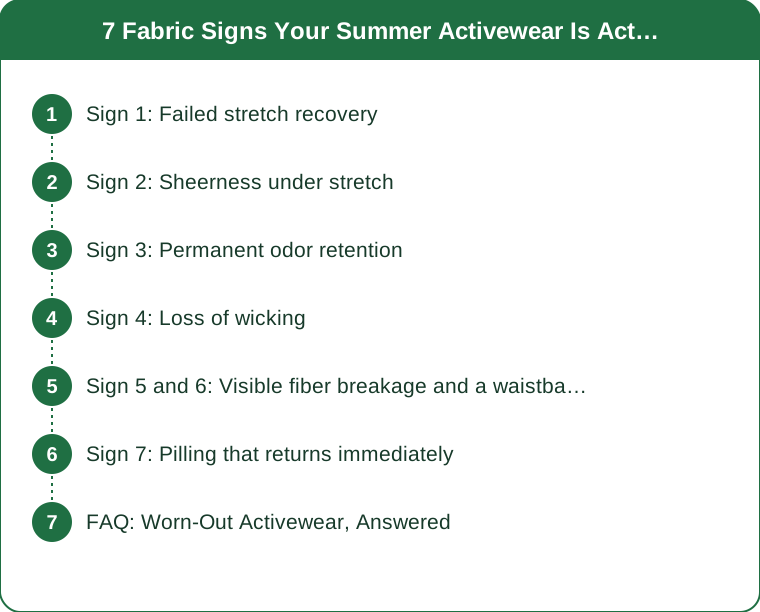
Quick Answer: Activewear fails through fabric degradation long before it looks obviously worn. The seven reliable signs: failed stretch recovery, sheerness under stretch, permanent odor retention, loss of wicking, visible elastane fiber breakage, waistband that no longer holds, and pilling that returns immediately after shaving. Fading and staining are cosmetic and are not on this list.
A summer of sweat, sunscreen, chlorine, and UV does specific things to performance fabric. Most of it is invisible until you know what to look for.
Seven signs, each with a test you can do in under a minute.

Sign 1: Failed stretch recovery
This is the most important sign on the list, because recovery is what makes activewear work at all.
Recovery is the fabric’s ability to return to its original dimensions after being stretched. It depends almost entirely on the elastane content, and elastane degrades with heat, UV, chlorine, salt, and oils — which is to say, with an ordinary summer.
The test: take a section of fabric on the thigh panel. Stretch it firmly, hold for ten seconds, then release and watch it.
- Good recovery: snaps back immediately with no visible slack or deformation.
- Degraded: stays visibly loose for a second or two before returning.
- Failed: does not return to its original shape at all.
Test the waistband separately, since it is often a different fabric and frequently fails first.
Why it matters practically: failed recovery is why leggings bag at the knees within twenty minutes, why the waistband slides down, and why a garment that fits when you put it on is loose by the end of the session. No washing, soaking, or care routine reverses broken elastane. Once the fibers themselves have failed, the garment is functionally done.
One important caveat: stretch loss from salt or oil buildup looks similar and is fully reversible. Before concluding a garment is finished, do a vinegar soak for salt and a warm dish-soap soak for oils, then retest. If it improves, it was clogged. If it does not, it is worn.
Sign 2: Sheerness under stretch
A garment that is opaque standing still and sheer in a squat has thinned past its useful life.
Why it happens: fibers abrade with wear and washing, and the knit structure opens up. Fabric weight — measured in GSM — effectively drops over the garment’s life, and once it falls below roughly 190 GSM, sheerness under stretch is essentially unavoidable regardless of the original quality.
The test — and do it correctly, because most people do it wrong:
Stand in bright natural daylight near a window, not in dim bedroom light. Squat fully and either have someone look, or use a phone camera on a timer from behind. Sheerness is entirely light-dependent, and the gym has bright overhead lighting that your bedroom does not.
What you are looking for: visible skin tone through the fabric, or a clear change in opacity between the relaxed and stretched state.
A common misdiagnosis: garments that were always slightly sheer and you only noticed now. If they were sheer from the first wear, that is a fabric weight problem from purchase, not degradation.
There is no fix. Fabric that has thinned cannot be thickened. This is a clear replacement signal for anything worn in public, and a straightforward demotion candidate for home use.
Sign 3: Permanent odor retention
The smell that returns within minutes of putting a garment on, even straight out of a clean wash.
Why it happens: synthetic fibers — particularly polyester — are oleophilic, meaning they attract and hold oils. Body oils and bacteria embed into the fiber structure itself, not just the surface. Over a summer of heavy sweating, that buildup accumulates in places detergent cannot reach.
The test: wash the garment normally, let it dry fully, then put it on and wear it for ten minutes at room temperature. If the smell returns before you have done anything, the odor compounds are in the fiber.
Before concluding it is permanent, try the reset:
- Vinegar soak — half a cup of white vinegar per gallon of cool water, 30 minutes, then rinse fully. This targets the alkaline residues and mineral buildup.
- If that fails, an enzyme-based sports detergent soak, following the product instructions, which targets the organic residues specifically.
- Never use fabric softener at any point, which coats fibers and traps exactly what you are trying to remove.
If two treatments do not resolve it, it is permanent. Polyester garments reach this state faster than nylon ones, and it is one of the more common ends for a summer-heavy garment.
Demotion still applies — a garment that smells within ten minutes is a poor gym choice and a fine gardening one.

Sign 4: Loss of wicking
The garment that used to move sweat away now just gets wet and stays wet.
Why it happens: moisture wicking depends on the capillary structure of the fabric — tiny channels between and within fibers that pull liquid along by surface tension. Sunscreen, body oils, fabric softener residue, and hard water minerals fill those channels. Once filled, the fabric behaves like any ordinary knit.
The test: hold the dry fabric flat and place a single drop of water on it.
- Working: the drop spreads and absorbs within a few seconds.
- Degraded: the drop sits on the surface, beads, or takes 15 seconds or more to absorb.
Test in more than one place — shoulders and upper back are the sunscreen zones and often fail first, while the lower body may still be fine.
This one is frequently reversible, which makes it worth testing before writing anything off. A warm soak with a teaspoon of plain dish soap per gallon, 20 minutes, rinsed extremely thoroughly, restores wicking on most garments where the cause is oil buildup. Rinse more than you think necessary — soap residue clogs just as effectively as sunscreen.
If two degreasing treatments do not restore it, the fiber surface treatment has likely degraded, and that is not recoverable.
Sign 5 and 6: Visible fiber breakage and a waistband that has given up
Sign 5 — Visible elastane fiber breakage
Hold the fabric up to a bright light and stretch it moderately. Look for tiny white or lighter-colored fibers visible within the stretched fabric, or a faint frosted appearance in high-stress areas.
That is broken elastane. Elastane is usually a different color from the main fiber, so when it snaps, the broken ends become visible as pale flecks. The most common locations are the inner thigh, the back of the knee, the seat, and the waistband.
This is unambiguous and irreversible. Once visible fiber breakage appears in an area, that area has lost a meaningful share of its stretch capacity and will keep losing more.
Sign 6 — A waistband that no longer holds
Waistbands fail before the rest of the garment because they carry the most sustained tension and are usually a different, more heavily elasticated construction.
The test: put the garment on and do ten deep squats, then check whether the waistband has migrated downward. Then stretch the waistband and release, watching for recovery.
Signs it is done: it slides during normal activity, it rolls over on itself, it feels loose from the moment you put it on, or the internal elastic is visibly rippled or wavy through the fabric.
Waistband replacement is possible for a tailor and occasionally worth it on an expensive garment, though it is rarely economical. More often, a failed waistband on an otherwise good garment is a demotion signal rather than a bin signal.
Sign 7: Pilling that returns immediately
Pilling itself is not a sign of a worn-out garment. Pilling that returns within one or two wears after shaving is.
Why the distinction matters: normal pilling is loose surface fibers tangling together. Shave them off and the surface is restored, sometimes for months. Recurring pilling means the fabric structure itself is breaking down — the yarn is shedding fibers continuously because the twist has loosened and the knit is degrading.
The test: shave the pilled area with a fabric shaver, then wear and wash the garment normally twice. If pills reappear in the same area within two wears, the fabric is failing rather than merely fuzzing.
Where it appears first: inner thighs, under bag straps, the seat, and anywhere with sustained friction. Recurring pilling in a high-friction zone is a reliable indicator that the zone has thinned.
One thing that makes pilling worse and is worth checking: washing with towels, denim, or anything with a rougher surface, and using a dryer at all. Both accelerate fiber loss dramatically. If pilling has appeared suddenly across a whole wardrobe, look at how you have been washing rather than at the garments.
Putting the seven together: a garment failing one sign is usually demotable or fixable. Two or three means it is done for performance use. Recovery failure plus sheerness together is the clearest replacement signal there is, because both are irreversible and both matter in public.
FAQ: Worn-Out Activewear, Answered
How long should activewear actually last?
With reasonable care, a well-made pair of leggings should stay in good condition for a couple of hundred wears. Laundry habits affect this far more than brand does — heat and fabric softener shorten life dramatically.
Can I fix stretched-out leggings?
If the stretch loss is from salt or oil buildup, yes — vinegar and dish-soap soaks reverse it. If the elastane fibers have broken, no. Test with a soak before deciding.
Is fading a sign they are worn out?
No, fading is cosmetic. Plenty of faded activewear performs perfectly, and plenty of vibrant activewear has failed recovery. Run the seven tests instead of judging by appearance.
What is the single most damaging thing I do to activewear?
The dryer, followed closely by fabric softener. Heat degrades elastane directly and softener coats the fibers, killing both wicking and odor resistance.
What should I do with garments that fail these tests?
Demote anything that still holds shape to home, garden, or sleep use — that is the longest-lasting form of value. Check for local textile takeback programs for genuinely finished items, since blended synthetics are difficult to recycle through normal channels.
TL;DR: Seven fabric tests that tell you when activewear is genuinely finished, not just faded.
- 1. Failed stretch recovery — stretch, hold ten seconds, release. No snap back means broken elastane. Soak first to rule out salt buildup.
- 2. Sheerness under stretch — squat test in bright daylight, not bedroom light. Irreversible.
- 3. Permanent odor — smell returns within ten minutes of a clean wash, after a vinegar soak and an enzyme soak both failed.
- 4. Loss of wicking — a water drop sits on the surface instead of absorbing. Usually reversible with a dish-soap degrease.
- 5. Visible fiber breakage — pale flecks in stretched fabric under bright light. Irreversible.
- 6. Waistband that migrates during ten squats, or has visibly rippled internal elastic.
- 7. Pilling that returns within two wears of shaving — the yarn itself is failing.
One sign means fix or demote. Recovery failure plus sheerness together means replace.
See It in Motion
Seen here: Super High Waist Embossed Yoga Leggings with Inner Pocket — shop it on bubblelime.com
Keep Reading
This article is for general informational and styling purposes only. Fit, sizing, and product availability may vary.