7 Fabric Weight Numbers on Activewear Labels and What They Actually Tell You
Quick Answer: GSM (grams per square meter) measures fabric density and weight — roughly under 180 GSM is lightweight and best for hot-weather or high-intensity use, 180-260 GSM is a versatile mid-weight for general training, and above 260 GSM is heavier, more compressive, and better suited to cooler weather or opacity-focused pieces like leggings.
The GSM number on a label looks like a random spec, but it’s actually one of the most reliable predictors of how a piece will feel and perform — here’s what each range actually means in practice.
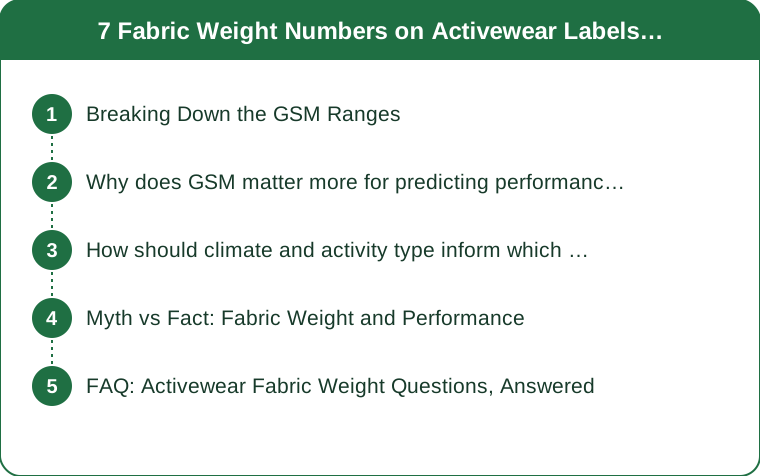
Breaking Down the GSM Ranges
Under 150 GSM — Ultra-Lightweight
This range shows up in the most breathable running and hot-yoga tops, prioritizing airflow and sweat evaporation above almost everything else, often at some cost to opacity and durability.
150-180 GSM — Lightweight
A common range for warm-weather tops and lighter leggings, balancing breathability with slightly more structure and durability than the ultra-lightweight tier.
180-220 GSM — Light-Mid Weight
A versatile range that works for a broad mix of activities and moderate climates, often the default weight for general-purpose training tops.
220-260 GSM — Mid-Weight
Common for leggings and higher-coverage tops, this range typically offers solid opacity (less see-through risk during squats and stretches) and moderate compression.
260-300 GSM — Heavy-Mid Weight
Offers strong compression and opacity, often found in premium leggings marketed for squat-proof performance, at some cost to breathability in hot conditions.
300-350 GSM — Heavyweight
This range shows up in cold-weather leggings, joggers, and structured jackets, prioritizing warmth and compression over breathability.
Above 350 GSM — Ultra-Heavyweight
Used for cold-weather outerwear and specialty compression pieces, this range trades almost all breathability for maximum structure, warmth, and compression.
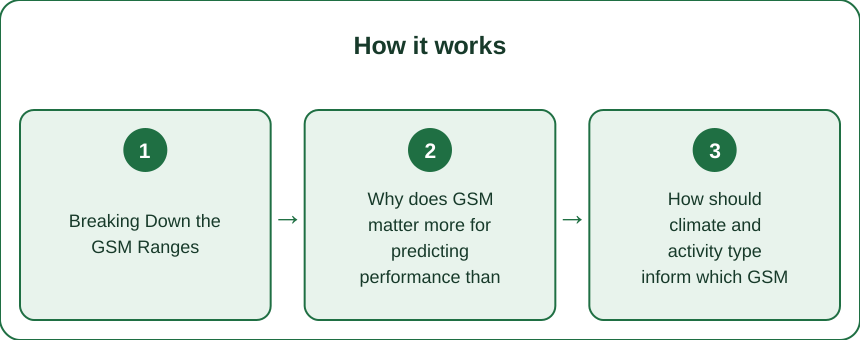
Why does GSM matter more for predicting performance than fabric name alone?
Two leggings both listed as ‘4-way stretch nylon-spandex blend’ can perform completely differently in terms of opacity, warmth, and compression depending on their actual GSM — the fiber blend name describes composition, while GSM describes density, and both matter, but GSM is the more direct predictor of how heavy, opaque, and structured a piece will actually feel on the body.
How should climate and activity type inform which GSM range to prioritize?
Hot climates and high-intensity, high-sweat activities generally do best with GSM under 220, prioritizing breathability, while cooler climates or lower-intensity activities where warmth and opacity matter more can comfortably go above 220 without the breathability tradeoff being as consequential.
Myth vs Fact: Fabric Weight and Performance
Myth: Heavier GSM always means higher quality. Fact: GSM indicates weight and density, not inherently quality — a well-made lightweight fabric can outperform a poorly constructed heavy one for its intended use.
Myth: GSM is the same as thread count in bedding. Fact: they’re different metrics entirely — GSM applies to fabric weight generally, unrelated to bedding-specific thread count measurements.
Myth: You can accurately guess a fabric’s GSM just by looking at a photo. Fact: GSM isn’t visually obvious and needs to be checked in the actual product description or label.
FAQ: Activewear Fabric Weight Questions, Answered
Is GSM information always listed on activewear product pages?
Not always — some brands list it explicitly, others only describe fabric qualitatively (‘lightweight,’ ‘compressive’), so checking reviews that mention actual performance is a good backup when the number isn’t provided.
Does higher GSM always mean less see-through risk?
Generally yes, higher GSM correlates with more opacity, though weave tightness and color also play a role, so GSM alone isn’t a perfect predictor of squat-test performance.
Can one piece of clothing have different GSM in different panels?
Yes — some technical activewear uses paneled construction with different fabric weights in different zones (lighter under the arms, heavier through the core) for targeted breathability and support.
TL;DR:
- GSM measures fabric weight and density, a more reliable performance predictor than fabric name alone
- Under 180 GSM favors breathability; 180-260 GSM is versatile; above 260 GSM favors compression and opacity
- Climate and activity intensity should guide which GSM range to prioritize for a given piece
- Higher GSM isn’t inherently higher quality — it’s a different tradeoff, not an upgrade
Next time you’re comparing two similar-looking leggings, check the GSM listed (or ask customer service) before assuming fabric name alone tells the whole story.
See It in Motion
Seen here: High Waist Yoga Leggings with Inner Pocket — shop it on bubblelime.com
Keep Reading
This article is for general informational and styling purposes only. Fit, sizing, and product availability may vary.