7 Ways Sunscreen and Chlorine Change Activewear Fabric
Quick Answer: Sunscreen and chlorine damage activewear through seven distinct mechanisms: avobenzone yellowing on light fabrics, titanium and zinc mineral deposits, oil residue that blocks moisture wicking, chlorine degradation of elastane, salt crystal abrasion, UV weakening of the fibers themselves, and odor bonding from residue that ordinary detergent cannot lift. Rinsing within an hour and a dedicated activewear wash reverses about half of them - the elastane damage and the UV damage are permanent.
At the end of August, most of a wardrobe’s visible aging happened chemically rather than through wear. Knowing which is which tells you what to save and what to retire.

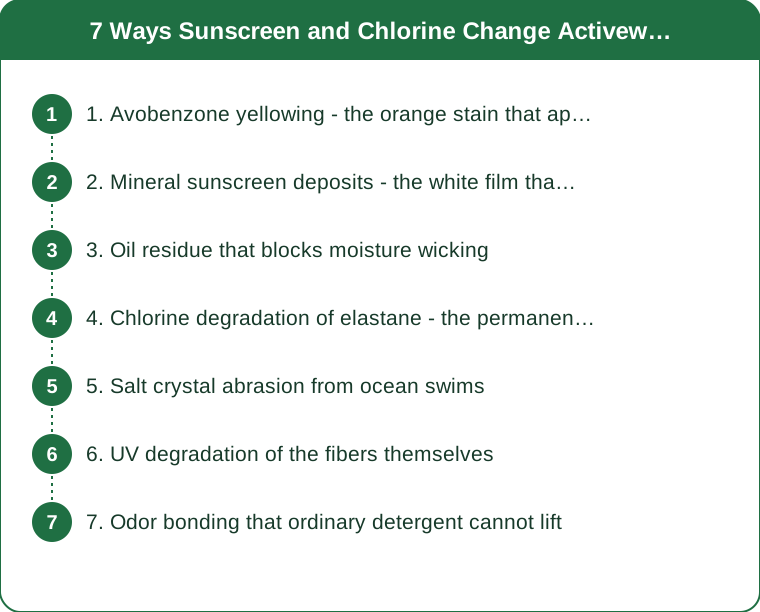
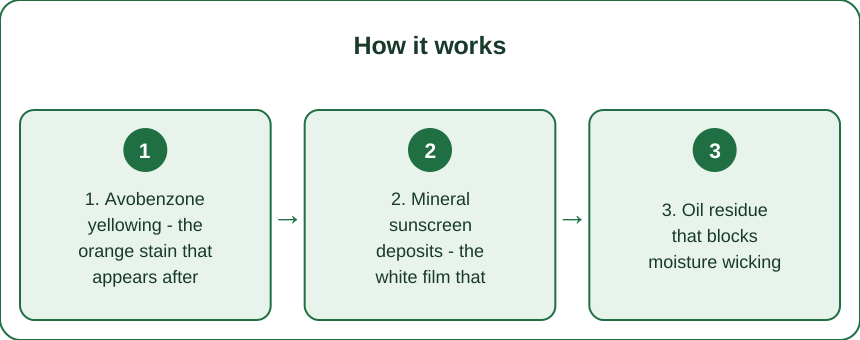
1. Avobenzone yellowing - the orange stain that appears after washing
The most confusing one, because it often appears after a wash rather than after wear.
The mechanism. Avobenzone is a common chemical UV filter. It reacts with iron, which is present in trace amounts in most tap water and in higher amounts in hard water areas. The reaction product is a rust-colored compound that binds to fabric.
Why after washing. The stain frequently develops or darkens when the garment goes through a wash cycle, because that is when the fabric meets a large volume of iron-containing water at temperature.
Where it shows. Light-colored fabrics only - white, cream, pale pink, light gray. On dark fabric it is invisible.
What helps. Rinse the garment in cool water before the sunscreen has time to sit. For an existing stain, an oxygen-based stain remover or a product formulated for rust removal on fabric will lift some of it, and repeated attempts do more than one aggressive one.
What makes it worse. Chlorine bleach, which reacts further and can set the discoloration permanently. Heat, which drives it into the fiber. If your water is hard, a water-softening laundry additive genuinely reduces recurrence.
2. Mineral sunscreen deposits - the white film that will not rinse out
Zinc oxide and titanium dioxide are physical particles rather than dissolved chemicals, and they behave differently.
The mechanism. These particles are fine solids suspended in a cream base. They lodge in the spaces between fibers in a knit and are held there physically, not chemically.
How it presents. A dull, slightly chalky look on dark fabric, particularly across the shoulders, back and anywhere the garment contacted skin. The fabric can also feel marginally stiffer.
Why detergent alone does not work. Detergent targets oils and dissolved soils. Mineral particles need to be physically dislodged.
What actually works. Turn the garment inside out, soak in cool water with a sport-specific detergent for 30 minutes, then wash with agitation. A second cycle is often needed after a heavy beach week.
Prevention beats treatment here. Let mineral sunscreen dry fully on skin - about 10 minutes - before putting on the garment. Most transfer happens from wet product, and that ten minutes eliminates the majority of it.
3. Oil residue that blocks moisture wicking
The most functionally significant item on this list and the least visible.
The mechanism. Moisture wicking works through capillary action - the fabric structure pulls water along fiber channels toward the outer surface where it evaporates. It depends on those channels being clear and on the fiber surface having the right affinity for water.
Sunscreen bases are oils and emulsifiers. They coat the fiber surface and fill the capillary spaces, and the coating is hydrophobic. So sweat that used to be pulled outward now sits against your skin.
How you notice. The garment feels clammy during a workout in a way it did not last spring, and it takes noticeably longer to dry. People usually blame the fabric wearing out. It is a coating.
The fix. A sport-specific detergent formulated to strip oils, on a cold cycle, with a full second rinse. One wash is often not enough after a summer of accumulation.
Fabric softener makes this dramatically worse by adding its own hydrophobic coating on top. If a wicking garment has stopped wicking and you use softener, that is the first thing to remove.

4. Chlorine degradation of elastane - the permanent one
This is the damage you cannot undo, and it is worth knowing so you stop trying.
The mechanism. Chlorine attacks the polyurethane segments that give elastane - spandex, Lycra - its elastic recovery. The polymer chains break, and once broken they do not reform. The fiber loses the ability to return to its original length.
How it presents. Sagging that appears when the garment is worn, a waistband that no longer grips, fabric that looks slightly wavy or bagged at the knee and seat. Critically, it does not recover after washing the way ordinary relaxation does.
Speed. Regular pool exposure degrades standard elastane blends noticeably within a single season of frequent swimming. Blends marketed as chlorine-resistant typically use a different elastic fiber and last considerably longer.
What limits it. Rinse in cool fresh water immediately after the pool - within minutes, not at the end of the day. Chlorine continues reacting while the garment is damp, so the rinse is doing real chemistry rather than just removing a smell.
What does not help. Nothing restores degraded elastane. Waistband tightening tricks address symptoms of a fiber that is finished.
5. Salt crystal abrasion from ocean swims
Less discussed than chlorine and mechanically real.
The mechanism. Seawater leaves dissolved salts behind as it evaporates. Those salts crystallize inside the fabric structure, and salt crystals are hard and angular. Every subsequent movement drags them across the fibers.
The effect. Accelerated abrasion and pilling, particularly at flex points - behind the knee, at the waist, under the arm. Fabric that feels stiff or crunchy after drying has visible crystal load.
Compounding factor. Salt is hygroscopic, so a salt-laden garment holds ambient moisture, which slows drying and encourages odor.
The fix is simple and time-sensitive. Rinse in fresh cool water before the garment dries. Once crystals form inside the knit they take a full soak to dissolve rather than a rinse.
A beach-day habit worth building: a gallon jug of fresh water in the car and a rinse before the drive home. Ninety seconds, and it addresses items 5 and 4 on this list simultaneously.
6. UV degradation of the fibers themselves
Sunscreen protects your skin. Nothing was protecting the fabric.
The mechanism. Ultraviolet radiation breaks chemical bonds in synthetic polymers through photodegradation. Nylon is notably more susceptible than polyester. Elastane is also affected.
How it presents. Fading first, then a subtle loss of tensile strength, then eventual thinning or splitting - often at the shoulder of a top or across the seat of a legging, which are the highest-exposure areas.
Cumulative and permanent. There is no treatment. What you can do is limit further exposure.
The largest single avoidable source is drying in direct sun. Line drying is excellent for fabric care generally, and doing it in full sun on a summer afternoon delivers a substantial UV dose to the garment every time. Dry in shade or indoors and you remove most of the avoidable exposure.
A practical implication for gear choice: if you swim, run or hike outdoors regularly, a polyester-dominant blend will hold up better over years than a nylon-dominant one, even though the nylon usually feels nicer new.
7. Odor bonding that ordinary detergent cannot lift
The end-of-summer smell that survives washing has a specific cause.
The mechanism. Synthetic fibers are oleophilic - they attract and hold oils. Body oils and sunscreen oils bind to the fiber surface, and odor compounds from bacteria bind to those oils. Standard detergent at cold temperature removes the surface layer and leaves the bound layer.
Why it reappears when you sweat. The residue is still there. Moisture and body heat release the trapped compounds, so the garment smells clean in the drawer and smells terrible ten minutes into a workout.
The reset that works. Soak for 30 to 60 minutes in cool water with either a sport detergent or a cup of white vinegar - not both, and never vinegar with bleach. Then wash normally without softener. For stubborn cases, an enzymatic sport wash used on its own with no other detergent is the strongest reasonable option.
Prevention through the season. Never leave damp gear in a bag - it is the single largest contributor. Wash within a day, cold, inside out, without softener.
The honest limit. If a garment has held odor for more than a season through repeated resets, the residue has bonded deeply enough that it is not coming out, and continuing to treat it is not a good use of anyone’s afternoon.
TL;DR:
- Seven distinct mechanisms damage summer activewear: avobenzone yellowing, mineral deposits, oil coating, chlorine degradation, salt abrasion, UV breakdown and bonded odor.
- Reversible with the right wash: yellowing (partly), mineral film, oil residue, salt, odor.
- Permanent: chlorine damage to elastane and UV degradation of the fibers.
- The two highest-value habits are rinsing in fresh cool water within minutes of a pool or beach, and never using fabric softener on technical fabric.
- Drying in shade instead of direct sun removes most avoidable UV exposure.
End-of-summer gear usually looks worse than it is. A proper strip wash restores function to a surprising share of it, and knowing which two mechanisms are permanent tells you exactly which pieces to stop trying to save.
See It in Motion
Seen here: High Waist Embossed Yoga Leggings with Side Pockets — shop it on bubblelime.com
Keep Reading
This article is for general informational and styling purposes only. Fit, sizing, and product availability may vary.