7 Numbers on Your Activewear Tag That Actually Tell You Something (and What They Mean)
Quick Answer: GSM (fabric weight), spandex/elastane percentage, denier (yarn thickness), and a handful of other tag numbers each predict a specific, checkable performance trait — opacity, stretch recovery, durability, or breathability — and reading them before buying catches problems (see-through fabric, poor recovery, low durability) that product photos never reveal.
Most shoppers skip straight past the small numbers on an activewear tag, but each one is a genuinely useful, checkable predictor once you know what it’s actually measuring.

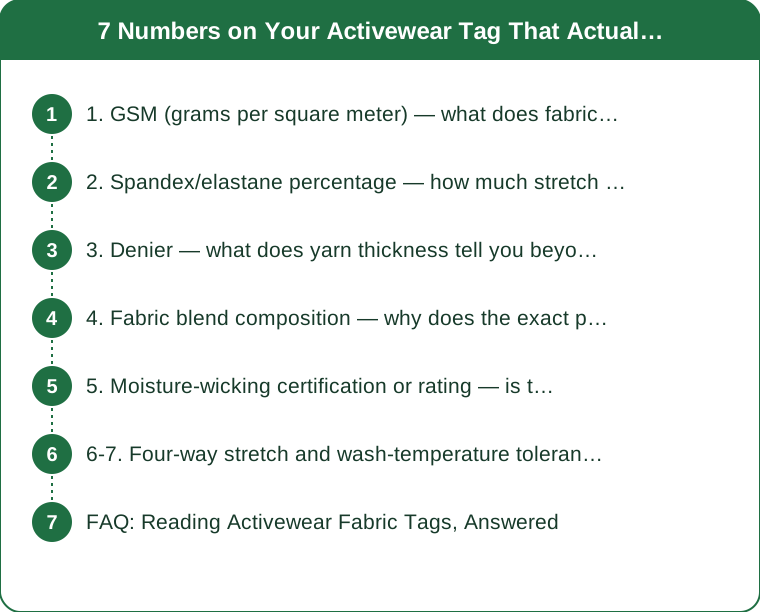
1. GSM (grams per square meter) — what does fabric weight actually predict?
GSM measures how much a square meter of the fabric weighs, which directly correlates with thickness and opacity — leggings under roughly 200 GSM are meaningfully more likely to be see-through under stretch (squats, lunges), while 250+ GSM fabric is generally considered a safer bet for full opacity. This single number is arguably the most useful predictor on the entire tag for anyone specifically worried about see-through fabric.
2. Spandex/elastane percentage — how much stretch content is actually enough?
A spandex percentage below roughly 5% tends to produce fabric with poor stretch recovery — meaning it stretches out during a workout and doesn’t fully snap back, leading to sagging or bagging over a session and faster long-term shape loss. Most well-performing activewear sits in the 8-20% spandex range, with higher percentages generally associated with better long-term recovery and shape retention.
3. Denier — what does yarn thickness tell you beyond just ‘thick or thin’?
Denier measures the thickness of the individual yarn fibers used, and higher denier generally correlates with greater abrasion resistance and durability, which matters especially for high-friction areas like inner thighs — lower denier fabric (common in ultra-lightweight, silky-feel leggings) tends to pill and wear through faster in those friction zones despite feeling nicer initially.

4. Fabric blend composition — why does the exact percentage split matter, not just the fiber types listed?
Two leggings can both list “nylon, polyester, spandex” but perform very differently depending on the actual percentage split — a higher nylon percentage generally feels smoother and more compressive, while a higher polyester percentage tends to feel slightly less premium but often wicks moisture somewhat better; the percentages, not just which fibers are present, determine the actual feel and performance.
5. Moisture-wicking certification or rating — is this number meaningful or just marketing language?
Some brands disclose actual moisture-wicking test ratings or reference a recognized standard, which is meaningfully more verifiable than the unquantified phrase “moisture-wicking” alone — the presence of any specific tested rating is a positive signal, while its complete absence doesn’t necessarily mean poor wicking, but does mean the claim can’t be independently checked.
6-7. Four-way stretch and wash-temperature tolerance — what do these two final details reveal?
Four-way stretch fabric stretches and recovers in both the lengthwise and widthwise directions, generally producing a more adaptive, comfortable fit across a wider range of movement than two-way stretch, which only stretches in one direction — this distinction is often listed directly on the tag or product description and meaningfully affects comfort during dynamic, multi-directional movement. Wash-temperature tolerance on the care label is a related clue: a lower recommended wash temperature (cold water only, no hot wash tolerance) often correlates with more delicate synthetic fiber blends that degrade faster under heat, while a fabric rated safe for warm water washing tends to be a more heat-tolerant, generally more durable blend.
FAQ: Reading Activewear Fabric Tags, Answered
Is GSM always printed on the tag, or do I need to look elsewhere for it?
GSM isn’t always printed on the physical garment tag specifically, but is increasingly listed in online product descriptions or spec sheets — checking the online listing before buying, not just the in-store tag, often reveals more of these numbers.
If a product doesn’t list any of these numbers, is that automatically a red flag?
Not automatically a red flag, but it does mean you’re relying entirely on reviews and photos rather than checkable specs — brands with nothing to disclose aren’t necessarily hiding poor quality, but the absence of data does shift the burden of verification onto reviews.
Which single number should someone check first if they only have time to check one?
GSM (fabric weight) is generally the highest-value single check for most shoppers, since it’s the most direct predictor of the most commonly reported problem — see-through fabric under stretch.
TL;DR:
- GSM (fabric weight) predicts opacity — 250+ GSM is a safer bet against see-through fabric
- Spandex percentage below 5% often means poor stretch recovery over time
- Higher denier means more abrasion resistance in high-friction areas
- The exact blend percentage split, not just which fibers are listed, determines real feel
- Four-way stretch and wash-temperature tolerance are both useful, checkable durability signals
The tag was never just legal fine print — it’s a genuine performance spec sheet once you know what each number predicts.
See It in Motion
Seen here: High Waist Yoga Leggings with Side Pockets — shop it on bubblelime.com
Keep Reading
This article is for general informational and styling purposes only. Fit, sizing, and product availability may vary.