7 Signs Your Activewear Fabric Is About to Fail (Before It Actually Does)
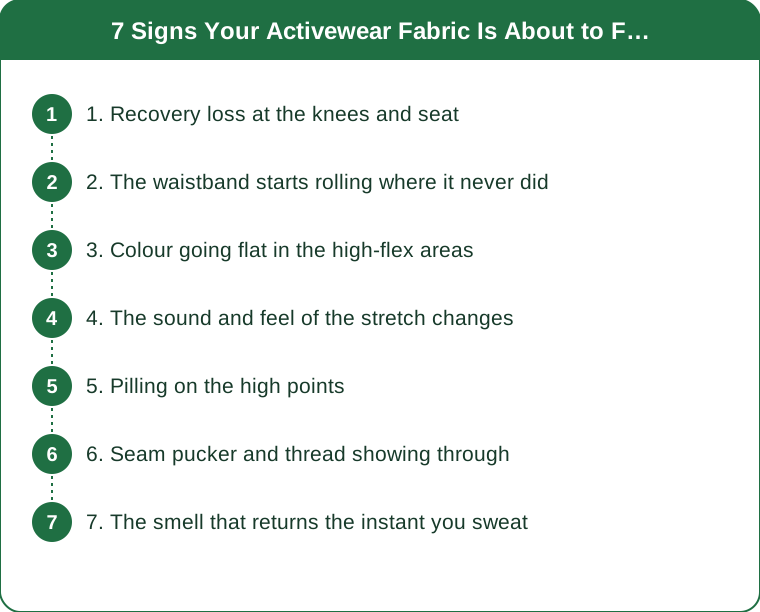
Quick Answer: Activewear fails through elastane degradation, and it announces itself long before the fabric goes sheer. The reliable early signs are recovery loss at the knees, a waistband that rolls where it did not, colour going flat in high-flex areas, a change in how the fabric sounds when stretched, pilling on high points, seam pucker, and a persistent smell that returns immediately on sweating. Catching the first three gives you months of useful life; waiting for transparency means the garment is already finished.
Most of these are also reversible or slowable, which is the part nobody mentions.

1. Recovery loss at the knees and seat
The first sign, and the one people rationalise away for the longest.
What it looks like. After 40 minutes of wear, the knees hold a slight bag that used to disappear. At first it recovers overnight; later it recovers only after a wash; eventually it does not recover.
What is happening. Elastane fibres are elastic polymers that lose recovery capacity through repeated extension, heat and chemical exposure. The knees and seat see the highest and most repeated extension, so they degrade first and by a wide margin.
The test. Put them on, sit for ten minutes, stand, and look at the knee. Note whether the fabric snaps back within a few seconds or holds shape. Doing this once a month on a favourite pair tells you more than any amount of guessing.
What accelerates it dramatically:
- Heat. Tumble dryers, hot washes, and leaving them in a hot car are the three big ones. Heat is the primary enemy of elastane and the effect is cumulative and permanent
- Chlorine, which destroys elastane rapidly. A hot tub is worse than a pool because heat and chlorine combine
- Fabric softener, which coats fibres and reduces both recovery and moisture movement
- Body oils and sunscreen, which degrade elastane over time if not washed out
What you can do at this stage. Wash cold, hang dry, rotate pairs so nothing is worn on consecutive days. Giving elastane 24 hours to recover between wears measurably extends its life, and it is the easiest change on this list.
2. The waistband starts rolling where it never did
A specific and reliable signal, because the waistband is usually a different construction from the body fabric.
Why it happens. The waistband either contains a higher elastane content, an elastic insert, or a different knit structure. When it loses recovery, it no longer holds tension evenly across its width, and the top edge folds outward.
The distinction that matters:
- Rolling that starts partway through wear is fabric fatigue, and it is a genuine end-of-life signal
- Rolling from the first minute on a new garment is a fit issue - usually the waistband is sitting at a point where your body circumference changes quickly
What accelerates waistband failure specifically:
- Pulling them on and off by the waistband, which is the highest-load event the garment experiences. Roll them down rather than dragging them up by the top edge
- Folding them over the waistband for storage, which holds it in a deformed position for days
- Body lotion and sunscreen at the waist, which sits directly against the highest-elastane part of the garment
Whether it can be fixed. Once the waistband has lost recovery, no. A hot wash to shrink it back is a widely repeated idea and it makes things worse - heat is what caused the degradation.
Practical adaptation. Waistband-failed leggings are still perfectly good for low-movement contexts - lounging, sleeping, gardening. This is where a garment moves down the rotation rather than out of it.
3. Colour going flat in the high-flex areas
Colour change is a fibre-condition signal, not just a cosmetic one.
What to look for. Compare the knee or seat with the calf or an inner seam allowance that has seen less stress. A lighter, chalkier, less saturated appearance in the high-flex area means the fibre surface has been abraded.
The mechanism. Repeated stretching, abrasion and washing damage the fibre surface. A roughened surface scatters light diffusely rather than reflecting it, which reads as faded even when little dye has actually been lost.
Why it matters beyond appearance. The same surface damage that changes the colour reduces the fabric’s abrasion resistance and increases how readily it pills, so this sign typically arrives shortly before sign 5.
What accelerates it:
- Washing with anything abrasive - towels, denim, anything with zips or hook fastenings
- Washing inside out is genuinely worth doing, because it moves the abrasion to the inner surface
- Direct sun drying on dark colours, which fades dye independently of the surface effect
- Detergent that is too strong or used in too high a dose, which is more common than under-dosing
A useful comparison method. Photograph a new pair once, in daylight, on a plain surface. A photo from six months later is far more informative than memory, which adjusts to gradual change without noticing.

4. The sound and feel of the stretch changes
The least known sign, and one of the earliest.
What to do. Hold the fabric with both hands and stretch it sharply across the grain, near your ear.
- New fabric produces a soft, dense, almost muted sound and a smooth resistance
- Degraded fabric sounds thinner and slightly papery, and the resistance feels less even - it gives easily and then stops
Why this works. Elastane running through the knit gives a consistent, progressive resistance. As it degrades, the knit structure carries more of the load and the response becomes less linear - which you can feel before you can see it.
The related hand test. Stretch a section 30 percent and hold it for five seconds.
- Good fabric resists at a consistent, increasing rate throughout
- Failing fabric gives easily at first, then hits a hard stop where the base knit takes over
Why it is worth knowing. This sign typically precedes visible signs by weeks or months. If you are deciding whether to buy a replacement now or in three months, this is the test that answers it.
It also works in shops. The same test on a garment you are considering distinguishes a well-constructed knit from a cheap one, before any wear at all.
5. Pilling on the high points
The sign everyone notices and most people misread.
Where it appears first. Inner thighs, seat, and the back of the knee - anywhere fabric rubs against itself or a surface. On textured fabrics, the raised areas pill first, because they take all of the abrasion.
What causes it. Short fibres work loose from the yarn and tangle into balls. Two things drive it: fibre quality and abrasion.
- Cheaper staple-fibre yarns pill much faster than long-filament yarns
- Abrasion from other garments in the wash is a bigger cause than abrasion from wear, which surprises most people
What actually reduces it:
- Wash activewear separately, or with other smooth synthetics only. Towels are the worst possible washing companion
- Inside out, cold, gentle cycle, mesh bag - the full set is worth doing on anything you want to keep
- Lower spin speed, which reduces the mechanical action considerably
Whether to remove pills. A fabric shaver removes them cleanly and does not damage the fabric if used gently on a flat surface. Picking at them by hand pulls yarn out of the knit and creates the small holes that appear later.
What pilling tells you about remaining life. Pilling alone is not end-of-life - plenty of otherwise sound garments pill. It becomes a real signal when it appears alongside signs 1 and 3, at which point the fabric surface is genuinely worn.
6. Seam pucker and thread showing through
The construction failing rather than the fabric, and it has a different timeline.
What it looks like. Flat seams start to ripple, or you can see the stitching thread through the fabric where you previously could not. Sometimes the seam looks fine relaxed and puckers under stretch.
Why it happens. Seam thread and fabric have different elasticity. As the fabric loses recovery, the two stop matching, and the seam - which has not changed - now gathers the fabric around it.
Where to look:
- The inner thigh seam, which sees the most stress and the most abrasion
- The crotch gusset junction, which is the highest-stress point on any legging
- The waistband join, particularly at the back
Why this one is urgent in a way the others are not. Seam failure at the inner thigh or gusset usually precedes an actual split by a short period, and unlike the other signs it fails suddenly. If seam pucker appears at the gusset, stop wearing them for anything public.
Whether it is repairable. A gusset seam can be restitched by anyone with a sewing machine and stretch thread, and it is worth doing on an otherwise sound garment. Regular thread will fail again immediately - stretch thread or a zigzag stitch is essential.
7. The smell that returns the instant you sweat
The sign that is most often blamed on the wash and is usually the fabric.
The pattern. The garment smells clean and dry. Within minutes of sweating, a strong smell appears that is out of proportion to how long you have worn it.
What is happening. Synthetic fibres are oleophilic - they attract and hold body oils. Over time, oils and bacterial residue build up in the fibre structure, and a standard wash removes surface soil without removing embedded oil. Sweat rehydrates the residue and the smell returns instantly.
The distinction that matters:
- Residue buildup is reversible. A cold soak with white vinegar for 30 minutes, or a dedicated sports detergent with enzymes, clears it in most cases
- Fibre-level degradation is not. If a deep clean does not fix it after two attempts, the fibre surface is damaged and holding residue permanently
The deep clean protocol, since it works often enough to always try first:
- Cold soak, 30 minutes, half a cup of white vinegar in a basin of water. Not with detergent - they neutralise each other
- Then a normal cold wash with a sports-specific or enzyme detergent, at half the usual dose
- Hang dry completely before storing. Storing anything even slightly damp is the fastest way to recreate the problem
What causes it in the first place:
- Leaving worn kit in a bag, which is the primary cause and is not close
- Fabric softener, which coats fibres and traps oils
- Overdosing detergent, which leaves residue that itself holds smell
When smell means end of life. If two full deep cleans have not worked, the garment is done for anything where you will sweat. It still has a life as loungewear, which is not nothing.
TL;DR:
- Recovery loss at knees and seat is the first sign - test monthly by sitting ten minutes and standing
- Heat is the primary killer of elastane: no dryer, no hot washes, no hot cars
- The stretch-sound test detects degradation weeks or months before anything is visible
- Seam pucker at the gusset is the one urgent sign, because it fails suddenly rather than gradually
- Persistent smell is usually reversible residue - try a cold vinegar soak before writing the garment off
Washing cold, hanging dry, and rotating pairs so nothing is worn two days running addresses five of these seven at once.
See It in Motion
Seen here: High Waist Embossed Yoga Leggings with Side Pockets — shop it on bubblelime.com
Keep Reading
This article is for general informational and styling purposes only. Fit, sizing, and product availability may vary.