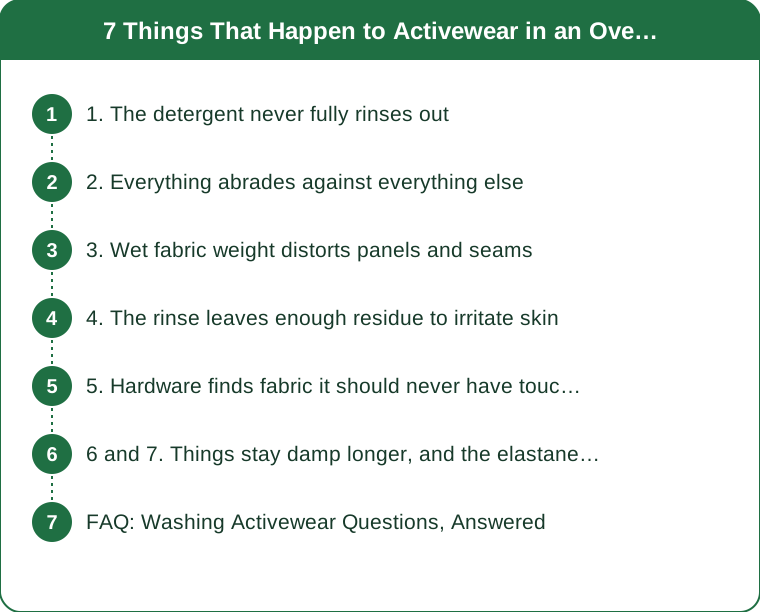
7 Things That Happen to Activewear in an Overloaded Washing Machine
Quick Answer: An overloaded machine cannot tumble properly, and tumbling is how washing works. The results for activewear are detergent residue that traps odour, mechanical abrasion and pilling, stretched and distorted panels from the weight of soaked fabric, poor rinsing that irritates skin, snagging from hardware, longer drying times that encourage bacteria, and accelerated elastane failure. A front loader should be filled to about three-quarters, with a hand’s width above the load.
The machine holds it. It closes. It runs. And it comes out looking washed, so nothing announces that anything went wrong. The damage from overloading is entirely cumulative, which is why the pair you have washed forty times in a packed drum looks two years older than the pair you have not.
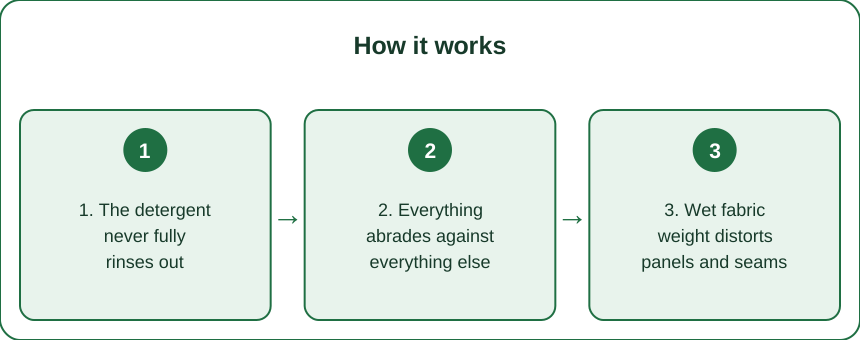
1. The detergent never fully rinses out
This is the biggest one, and it is the cause of the complaint people make most often about activewear.
Washing works by mechanical action - fabric moving through water, water moving through fabric. In an overloaded drum, the clothes form a dense mass that water cannot penetrate evenly. Detergent gets into the outside of the mass and stays there, and the rinse cycle cannot flush it out because the same blockage applies in reverse.
On cotton, residue is mildly annoying. On technical knits it is a functional problem. Detergent residue coats fibres, which reduces wicking, stiffens the hand feel, and - critically - creates a surface that holds body oils and the bacteria that feed on them.
If your leggings smell fine out of the wash and then smell within ten minutes of putting them on, this is almost always the cause. The odour is not coming back; it never left, because it is bound into residue that the rinse could not reach.
The fix is two-part: use less detergent than the cap suggests - roughly half for a lightly soiled technical load - and stop overloading so the rinse can do its job. An extra rinse cycle helps but treats the symptom.
2. Everything abrades against everything else
In a properly loaded drum, garments tumble - they lift, fall, and move through water with space around them. In an overloaded drum they cannot lift, so instead of tumbling they grind against each other under pressure for the entire cycle.
That grinding is exactly the mechanical abrasion that produces pilling. Fibre ends are worked loose from the yarn, they tangle with neighbouring loose ends, and they ball up into pills. A single overloaded cycle can do the pilling damage of several correctly loaded ones, because pressure plus friction is a much more aggressive combination than free tumbling.
It is worse for anything with a raised texture, a brushed finish, or a soft hand - which describes most of the activewear people care about, because softness comes from a looser fibre structure that gives up fibre ends more readily.
A mesh laundry bag helps by isolating each garment from direct contact, but it does not solve the underlying problem: a bag inside a jammed drum is still a jammed drum. The bag is a supplement to correct loading, not a substitute for it.
3. Wet fabric weight distorts panels and seams
Soaked activewear is heavy. A pair of leggings that weighs 200g dry can hold several times that in water, and in an overloaded machine that weight is pressed and dragged against other garments for an hour.
The result is distortion at the weakest points, which in activewear means the seams and the panel joins. Compressive knits are engineered with different tensions in different panels - that is what makes them shape and support - and sustained uneven pressure while wet is precisely the condition that lets those tensions equalise permanently.
The symptom shows up as a pair that fits differently than it used to, in a way that is hard to describe. Not stretched out overall - just slightly wrong at the back rise, or bagging at the knee, or a waistband that has lost its grip on one side.
Spin speed compounds it. A high spin in an unbalanced overloaded drum applies enormous, uneven centrifugal force to whatever is on the outside of the mass. Dropping to a medium spin for activewear loads is a genuinely worthwhile setting change, and technical knits dry fast enough that the extra water is not a problem.
4. The rinse leaves enough residue to irritate skin
Poor rinsing does not only affect the fabric. Detergent residue against skin, under compression, during sweating, is a recognised cause of contact irritation - particularly at the waistband and the inner thigh where pressure and friction are highest.
People who develop a rash or itching in activewear frequently assume a fabric sensitivity and switch brands. Often the actual variable is how the garment was washed. Running a suspect pair through two rinse cycles with no detergent at all, and seeing whether the problem resolves, is a five-minute diagnostic worth doing before buying anything.
Fragranced detergents and softeners make it substantially more likely, because fragrance compounds are among the more common contact allergens and they are designed to bind to fabric and persist.
For anyone with sensitive skin, the combination that works is: a fragrance-free detergent, half the recommended dose, a correctly loaded drum, and an extra rinse. If irritation persists despite this, see a healthcare professional rather than continuing to experiment. This is general information, not medical advice.
5. Hardware finds fabric it should never have touched
In a loaded drum with room to move, garments circulate and contact is brief and glancing. In a packed drum, whatever is next to what stays next to what for the whole cycle.
That means a bra hook resting against a mesh panel is resting against that mesh panel for 55 minutes, under pressure, moving slightly, continuously. Zip teeth, denim rivets, buttons, and velcro do the same thing. The result is snags, pulls, and small holes that appear in places with no obvious cause.
Mesh panels and lightweight knits are the most vulnerable, and they are also the most expensive parts of the garments they appear on. A single snagged thread in a mesh panel is usually terminal for the look of the garment, because there is no way to repair it invisibly.
The rules are boring and effective: fasten every hook, zip, and velcro closure before washing; keep activewear away from denim and towels entirely; and use mesh bags for anything with mesh, lace, or fine detail. This one costs nothing but a habit.
6 and 7. Things stay damp longer, and the elastane gives up years early
6. The load comes out wetter and stays damp
An overloaded drum spins badly. The load cannot distribute evenly, so the machine either reduces the spin speed automatically to protect itself, or spins unevenly and leaves the inside of the mass considerably wetter than the outside.
That matters for activewear more than for other laundry because of what lives in it. Synthetic fabric that stays damp for many hours is a favourable environment for the bacteria responsible for persistent activewear odour - and those bacteria are the reason a technical top can smell within minutes of being worn even though it was clean.
The compounding effect is the problem: residue from poor rinsing feeds the bacteria, and long damp time gives them the conditions to multiply. Overloading produces both at once, which is why it is so much more damaging to activewear than to a load of towels.
Getting the load out promptly and hanging it with air on both sides is the fix. Not on a radiator, which degrades elastane, and not bunched on a hanger. Over a rail with the garment opened out, ideally with some air movement in the room.
7. The elastane gives up years early
Elastane - spandex, lycra - is what makes activewear stretch and, more importantly, recover. It is also the most fragile component in the fabric, and it fails from three things: heat, chemical exposure, and mechanical stress.
An overloaded wash delivers the second and third generously. Concentrated detergent that does not rinse out is prolonged chemical exposure. Grinding under pressure for a full cycle is sustained mechanical stress. Add a hot wash or a tumble dryer and all three arrive together.
Elastane failure is what people are describing when they say a pair has “gone baggy” - the fabric still stretches, it just no longer returns. Once recovery is gone it does not come back, and no amount of careful washing afterwards helps.
The full protection list, ranked: never tumble dry, wash cold, never use fabric softener, load the drum to three-quarters, use half the detergent, medium spin, and rotate between pairs so each has 24 hours to recover between wears.
Seven habits. The first three matter most, and the fourth - which is the one this article is about - quietly enables all the others to work.
FAQ: Washing Activewear Questions, Answered
How full should a washing machine be for activewear?
About three-quarters full, with roughly a hand’s width of space above the load when it is sitting in the drum. The clothes need room to lift and tumble; if they are packed tightly enough to stay in place, the machine cannot clean or rinse them properly.
Why does my activewear smell even after washing?
Almost always detergent residue that did not rinse out, which coats the fibres and holds body oils and odour-producing bacteria. Use half the recommended detergent, do not overload the drum, add an extra rinse, and never use fabric softener.
Does overloading really damage clothes?
Yes, and technical fabric more than most. Garments grind against each other under pressure rather than tumbling freely, which accelerates pilling, distorts panels while wet, causes snagging from hardware, and leaves residue that degrades elastane. The damage is cumulative and largely invisible per cycle.
What spin speed should I use for leggings?
Medium rather than maximum. High-speed spinning in an unevenly loaded drum applies severe uneven force to the outside of the load, which distorts compressive panels. Technical knits dry quickly enough that the extra retained water is not an issue.
TL;DR:
- Three-quarters full, hand’s width of air above the load. That is the whole rule.
- Overloading causes residue that traps odour - the number one activewear complaint.
- Grinding under pressure pills fabric far faster than free tumbling does.
- Fasten all hardware, use mesh bags, and never wash activewear with denim or towels.
- Half the detergent, cold water, medium spin, no dryer, no softener.
The machine will happily accept twice what it should wash. It just will not tell you that it stopped washing properly somewhere around the halfway mark.
See It in Motion
Seen here: Super High Waist Embossed Yoga Leggings with Inner Pocket — shop it on bubblelime.com
Keep Reading
This article is for general informational and styling purposes only. Fit, sizing, and product availability may vary.